Best Books for Jammu Kashmir Teacher Eligibility Test (JKTET)
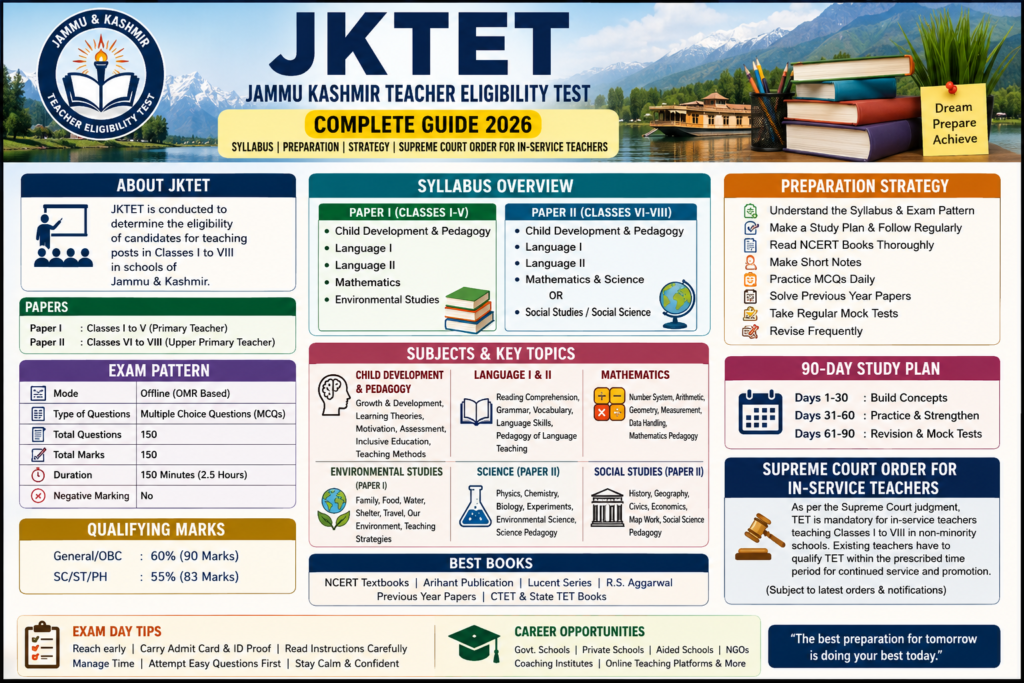
Jammu Kashmir Teacher Eligibility Test. JKTET 2026, JK TET Exam, JKTET Eligibility, JKTET Exam Pattern, JKTET Preparation, JK Teacher Recruitment
Jammu Kashmir Teacher Eligibility Test (JKTET) 2026: Complete Guide, Eligibility, Exam Pattern & Preparation. Learn everything about the Jammu Kashmir Teacher Eligibility Test (JKTET), including eligibility, exam pattern, selection process, validity, preparation tips, and complete syllabus. Read this comprehensive guide to kickstart your teaching career.
Jammu Kashmir Teacher Eligibility Test (JKTET): The Complete Guide for Aspiring Teachers
Teaching is one of the most respected and rewarding professions in India. Every year, thousands of graduates and aspiring educators dream of securing a government teaching job in Jammu & Kashmir. The first and most important milestone in achieving this goal is qualifying the Jammu Kashmir Teacher Eligibility Test (JKTET).
Whether you aspire to teach in primary schools (Classes I-V) or upper primary schools (Classes VI-VIII), qualifying the JKTET is an essential requirement for becoming eligible for teaching positions in government and many private schools.
However, many aspirants struggle with questions such as:
- What is JKTET?
- Who can apply?
- What is the eligibility criteria?
- How difficult is the exam?
- What is the exam pattern?
- How should one prepare?
This comprehensive guide answers all these questions and provides a roadmap to crack the examination successfully.
What is Jammu Kashmir Teacher Eligibility Test (JKTET)?
The Jammu Kashmir Teacher Eligibility Test (JKTET) is a state-level eligibility examination conducted to determine whether candidates possess the minimum qualifications and teaching aptitude required for appointment as teachers in schools across Jammu & Kashmir.
The examination follows the guidelines laid down by the National Council for Teacher Education (NCTE) and serves as a benchmark for assessing candidates’ pedagogical knowledge, subject understanding, and teaching competencies.
Unlike recruitment examinations, JKTET does not directly provide employment. Instead, it certifies that a candidate is eligible to apply for teaching vacancies announced by recruiting authorities.
In simple words,
JKTET is an eligibility certificate—not a recruitment exam.
Qualifying this examination significantly enhances a candidate’s prospects of securing teaching positions in government and recognized educational institutions.
Why is JKTET Important?
The teaching profession requires more than academic knowledge. Teachers must understand child psychology, classroom management, effective teaching methodologies, and subject-specific pedagogy.
JKTET evaluates these competencies to ensure that qualified candidates can provide quality education aligned with modern educational standards.
Some key reasons why JKTET is important include:
- Acts as the minimum qualification for teacher recruitment.
- Enhances professional credibility.
- Demonstrates understanding of child-centered education.
- Improves chances of selection in teaching recruitment.
- Encourages better teaching standards across schools.
- Ensures compliance with national education norms.
Objectives of JKTET
The examination has been designed with several educational objectives.
These include:
- Identifying qualified teachers.
- Improving educational standards.
- Assessing teaching aptitude.
- Evaluating pedagogical knowledge.
- Promoting quality classroom instruction.
- Encouraging continuous professional development.
- Ensuring uniform standards in teacher recruitment.
Ultimately, the goal is to provide competent teachers who can contribute to holistic student development.
Who Conducts the JKTET Examination?
The JKTET examination is conducted by the designated education authority of the Government of Jammu & Kashmir. The conducting authority releases the official notification containing information regarding:
- Online application dates
- Eligibility conditions
- Examination schedule
- Admit cards
- Answer keys
- Result declaration
- Eligibility certificates
Candidates should regularly check the official notification for the latest updates related to the examination.
Who Should Apply for JKTET?
The examination is suitable for individuals who aspire to become teachers in government or recognized schools.
The following candidates should consider appearing for JKTET:
- B.Ed graduates
- D.El.Ed diploma holders
- BSTC holders
- Elementary education students
- Teacher training graduates
- Fresh graduates planning a teaching career
- Candidates preparing for teacher recruitment examinations
If your goal is to build a stable and respected career in teaching, JKTET is one of the first milestones.
Types of JKTET Papers
The examination consists of two separate papers.
Paper I
Paper I is intended for candidates who wish to teach:
- Classes I to V
These are primary school teaching positions.
Paper II
Paper II is designed for candidates aspiring to teach:
- Classes VI to VIII
These are upper primary teaching positions.
Both Papers
Candidates interested in teaching from Classes I to VIII may appear for both papers, provided they satisfy the eligibility criteria for each.
JKTET Eligibility Criteria
One of the most frequently asked questions among aspirants concerns eligibility. While the detailed criteria are specified in the official notification, the broad requirements are as follows.
Educational Qualification for Paper I
Candidates should generally possess:
- Senior Secondary qualification with the prescribed minimum marks, along with a Diploma in Elementary Education (D.El.Ed.) or an equivalent teacher training qualification,
or
- Graduation with the required teacher education qualification as per the prevailing NCTE norms.
Educational Qualification for Paper II
Candidates should generally have:
- Graduation from a recognized university along with a Bachelor of Education (B.Ed.),
or
- Graduation with an Elementary Education qualification, where applicable under current regulations.
Important Note: Eligibility requirements may be revised from time to time in accordance with NCTE guidelines. Candidates should always refer to the latest official notification before applying.
Is There Any Age Limit?
Generally, candidates meeting the prescribed educational qualifications are eligible to apply. Specific age conditions, if any, are notified in the recruitment or examination advertisement.
It is advisable to check the latest official notification for updated information regarding age eligibility.
Is There Any Restriction on Number of Attempts?
One of the biggest advantages of JKTET is that there is generally no restriction on the number of attempts for eligible candidates. Aspirants may reappear to improve their performance or qualify if unsuccessful in previous attempts, subject to the rules in force at the time of the examination.
JKTET Exam Pattern
Understanding the examination pattern is crucial before beginning preparation.
The JKTET examination consists entirely of objective-type multiple-choice questions (MCQs).
There is generally one mark for each correct answer, and candidates are required to choose the most appropriate option from the choices provided.
Paper I Exam Pattern
| Subject | Questions | Marks |
|---|---|---|
| Child Development & Pedagogy | 30 | 30 |
| Language I | 30 | 30 |
| Language II | 30 | 30 |
| Mathematics | 30 | 30 |
| Environmental Studies | 30 | 30 |
| Total | 150 | 150 |
Paper II Exam Pattern
| Subject | Questions | Marks |
|---|---|---|
| Child Development & Pedagogy | 30 | 30 |
| Language I | 30 | 30 |
| Language II | 30 | 30 |
| Mathematics & Science (for Mathematics/Science teachers) or Social Studies (for Social Science teachers) | 60 | 60 |
| Total | 150 | 150 |
Duration of Examination
The examination duration is generally:
2 Hours 30 Minutes (150 Minutes)
Candidates should develop effective time management skills to complete all questions within the allotted time.
Mode of Examination
JKTET is typically conducted as an offline examination using OMR sheets, where candidates mark their responses with a blue or black ballpoint pen. The mode of examination is specified in the official notification and should be verified before the exam.
Is There Negative Marking?
According to the prevailing JKTET pattern, there is generally no negative marking for incorrect answers. This allows candidates to attempt all questions strategically, even if they need to make educated guesses.
Minimum Qualifying Marks
To qualify for JKTET, candidates must secure the minimum percentage of marks prescribed in the official notification.
The qualifying standard may vary depending on the candidate’s category and applicable government rules.
Qualifying JKTET awards an eligibility certificate but does not guarantee appointment. Candidates must still participate in teacher recruitment processes conducted by the competent authorities.
Validity of the JKTET Certificate
Candidates who qualify JKTET receive an eligibility certificate that can be used while applying for eligible teaching posts, subject to the validity period and rules notified by the Government of Jammu & Kashmir. Aspirants should verify the current validity provisions mentioned in the latest notification.
Why Thousands of Aspirants Fail Despite Good Preparation
Many candidates dedicate months to preparation but fail because they focus only on memorizing facts. JKTET is designed to test:
- Conceptual understanding
- Teaching aptitude
- Classroom application
- Child psychology
- Logical thinking
- Pedagogical skills
Understanding the JKTET Syllabus
Before purchasing books or starting your preparation, it is essential to understand the syllabus thoroughly. The JKTET syllabus is based on the curriculum prescribed by the National Council for Teacher Education (NCTE) and focuses on assessing a candidate’s teaching aptitude, pedagogical understanding, and subject knowledge.
The syllabus is divided into two papers:
Paper I (Classes I–V)
Designed for candidates who wish to become Primary School Teachers.
It includes five sections:
- Child Development & Pedagogy
- Language I
- Language II
- Mathematics
- Environmental Studies
Paper II (Classes VI–VIII)
Designed for candidates aspiring to teach Upper Primary Classes.
It includes:
- Child Development & Pedagogy
- Language I
- Language II
- Mathematics & Science (for Science/Mathematics teachers)
OR
- Social Studies/Social Science (for Social Science teachers)
JKTET Child Development & Pedagogy Syllabus
This section is considered the heart of the examination because it evaluates your understanding of how children learn and develop.
Important Topics
Child Development
- Growth and Development
- Principles of Development
- Cognitive Development
- Physical Development
- Emotional Development
- Social Development
- Moral Development
- Language Development
Learning Process
- Nature of Learning
- Factors Affecting Learning
- Individual Differences
- Learning Theories
- Constructivism
- Motivation
- Intelligence
- Creativity
Inclusive Education
- Children with Special Needs
- Learning Disabilities
- Inclusive Classroom
- Teaching Diverse Learners
- Equal Learning Opportunities
Assessment
- Formative Assessment
- Summative Assessment
- Diagnostic Assessment
- Continuous and Comprehensive Evaluation (CCE)
- Evaluation Techniques
Teaching Methods
- Child-Centered Learning
- Activity-Based Learning
- Play-Way Method
- Project Method
- Cooperative Learning
- Experiential Learning
Best Books for Child Development & Pedagogy
1. Child Development & Pedagogy – Arihant Publications
One of the most recommended books with previous year questions and practice sets.
2. Child Development & Pedagogy – Pearson
Ideal for conceptual understanding.
3. CTET & TET Child Development – Disha Publications
Useful for practicing objective questions.
Language I Syllabus
Language I generally evaluates proficiency in the language selected by the candidate and the ability to teach that language effectively.
Topics
- Reading Comprehension
- Grammar
- Vocabulary
- Sentence Formation
- Language Skills
- Pedagogy of Language Development
- Language Acquisition
- Teaching Methods
- Communication Skills
Language II Syllabus
Language II focuses on understanding another language and teaching methodologies.
Important areas include:
- Reading Skills
- Writing Skills
- Grammar
- Comprehension
- Language Learning
- Teaching Techniques
- Literature Appreciation
- Classroom Communication
Best Books for Language Preparation
English
- Objective General English – S.P. Bakshi
- High School English Grammar & Composition – Wren & Martin
- Lucent General English
Hindi
- Lucent Hindi
- Arihant Hindi Grammar
Urdu
Candidates should practice from standard Urdu grammar books, school textbooks, and previous TET papers.
Mathematics Syllabus (Paper I)
The Mathematics section assesses conceptual understanding and the ability to teach mathematics at the primary level.
Number System
- Natural Numbers
- Whole Numbers
- Integers
- Fractions
- Decimals
- Rational Numbers
Arithmetic
- Addition
- Subtraction
- Multiplication
- Division
- LCM
- HCF
- Average
- Percentage
- Profit and Loss
- Simple Interest
Geometry
- Basic Shapes
- Angles
- Triangles
- Circles
- Symmetry
- Perimeter
- Area
Measurement
- Length
- Weight
- Capacity
- Time
- Money
Data Handling
- Tables
- Bar Graphs
- Pictographs
- Charts
Mathematics Pedagogy
- Nature of Mathematics
- Teaching Strategies
- Learning Difficulties
- Error Analysis
- Evaluation Methods
Best Mathematics Books
R.S. Aggarwal Mathematics
Excellent for strengthening basic concepts.
NCERT Mathematics (Classes I–VIII)
Highly recommended since many questions are based on NCERT concepts.
Arihant TET Mathematics
Useful for exam-oriented preparation.
Environmental Studies (EVS) Syllabus
EVS carries 30 marks in Paper I and focuses on understanding the environment around us and effective teaching methodologies.
Important Topics
Family and Friends
- Relationships
- Work and Play
- Animals
- Plants
Food
- Nutrition
- Balanced Diet
- Sources of Food
- Healthy Eating Habits
Water
- Sources
- Conservation
- Rainwater Harvesting
- Pollution
Shelter
- Types of Houses
- Construction Materials
- Cleanliness
Travel
- Means of Transport
- Road Safety
- Communication
Things We Make and Do
- Occupations
- Community Helpers
- Science in Daily Life
EVS Pedagogy
- Nature of EVS
- Teaching Strategies
- Activity-Based Learning
- Environmental Awareness
Best EVS Books
- NCERT EVS Classes III–V
- Arihant Environmental Studies
- Disha EVS for CTET/TET
Science Syllabus (Paper II)
Candidates opting for Mathematics & Science in Paper II should prepare the following topics.
Physics
- Motion
- Force
- Energy
- Heat
- Light
- Sound
- Electricity
- Magnetism
Chemistry
- Matter
- Elements
- Compounds
- Acids
- Bases
- Salts
- Chemical Reactions
Biology
- Cell
- Human Body
- Nutrition
- Respiration
- Reproduction
- Ecosystem
- Heredity
Science Pedagogy
- Scientific Method
- Experiments
- Laboratory Teaching
- Observation Skills
- Learning Difficulties
Best Science Books
- NCERT Science Classes VI–X
- Lucent General Science
- Arihant Science for TET
Social Studies Syllabus (Paper II)
Candidates opting for Social Science should prepare the following areas.
History
- Ancient India
- Medieval India
- Modern India
- Freedom Movement
Geography
- Earth
- Globe
- Maps
- Climate
- Resources
- Agriculture
Political Science
- Constitution
- Democracy
- Fundamental Rights
- Parliament
- Judiciary
- Local Government
Economics
- Economy
- Banking
- Budget
- Poverty
- Employment
Social Studies Pedagogy
- Teaching Social Science
- Learning Resources
- Map Work
- Project-Based Learning
Best Social Studies Books
- NCERT History Classes VI–X
- NCERT Geography Classes VI–X
- NCERT Political Science
- Lucent General Knowledge
- Arihant Social Studies
Best Books for Jammu Kashmir Teacher Eligibility Test (JKTET)
Below is a curated list of books that can help candidates prepare effectively for the JKTET examination.
| Subject | Recommended Book | Author/Publisher |
|---|---|---|
| Child Development & Pedagogy | Child Development & Pedagogy | Arihant |
| Mathematics | Quantitative Aptitude | R.S. Aggarwal |
| Environmental Studies | EVS for CTET & TET | Arihant |
| English | Objective General English | S.P. Bakshi |
| English Grammar | High School English Grammar & Composition | Wren & Martin |
| Hindi | Hindi Grammar | Arihant |
| Science | NCERT Science VI–X | NCERT |
| Social Studies | NCERT History, Geography, Political Science | NCERT |
| General Knowledge | Lucent General Knowledge | Lucent Publications |
| Previous Papers | CTET & State TET Solved Papers | Arihant/Disha |
Subject-wise Preparation Tips
Child Development & Pedagogy
- Focus on concepts rather than memorization.
- Understand educational psychology and classroom scenarios.
- Practice pedagogy-based MCQs regularly.
Languages
- Improve grammar and vocabulary.
- Read newspapers and children’s literature.
- Solve comprehension passages every day.
Mathematics
- Strengthen basic concepts from NCERT books.
- Practice calculations without a calculator.
- Revise formulas and solve topic-wise MCQs.
Environmental Studies
- Relate concepts to daily life.
- Focus on teaching methods and pedagogy.
- Revise NCERT textbooks thoroughly.
Science
- Build conceptual clarity using NCERT books.
- Understand diagrams, experiments, and applications.
- Revise frequently asked scientific facts.
Social Studies
- Prepare chronological events in history.
- Practice map-based questions.
- Focus on the Constitution, governance, and geography fundamentals.
Common Mistakes to Avoid During Syllabus Preparation
Many candidates fail to qualify despite studying hard because they make avoidable mistakes:
- Ignoring the pedagogy section.
- Skipping NCERT textbooks.
- Relying only on guidebooks.
- Not practicing previous year papers.
- Neglecting language preparation.
- Studying without a timetable.
- Failing to revise regularly.
- Ignoring mock tests.
Avoiding these mistakes can significantly improve your performance.
Key Takeaways
- Start your preparation with the official syllabus.
- Build strong conceptual foundations using NCERT books.
- Prioritize Child Development & Pedagogy, as it plays a crucial role in both papers.
- Choose standard reference books and avoid collecting too many resources.
- Solve topic-wise MCQs after completing each section.
- Revise consistently and practice previous years’ question papers.
Table of Contents
- How to Prepare for JKTET
- 90-Day Study Plan
- Daily Study Schedule
- Subject-wise Preparation Strategy
- Importance of NCERT Books
- Previous Year Papers Strategy
- Mock Test Preparation
- Last 30-Day Revision Plan
- Exam Day Tips
- Common Mistakes to Avoid
- Career Opportunities After JKTET
- Salary of Teachers in Jammu & Kashmir
- Frequently Asked Questions
- Final Words
How to Prepare for JKTET Successfully
Many candidates believe that JKTET is difficult because of the vast syllabus. In reality, the examination is more about conceptual clarity, pedagogy, and consistent practice than rote learning.
A successful preparation strategy should include:
- Understanding the complete syllabus before starting.
- Studying from limited but reliable resources.
- Making concise revision notes.
- Solving topic-wise MCQs daily.
- Practicing previous year papers.
- Taking regular mock tests.
- Revising consistently.
The key is quality of study, not just the number of hours.
90-Day JKTET Preparation Plan
A structured plan helps you cover the syllabus without feeling overwhelmed.
Phase 1: Build Concepts (Days 1–30)
Focus on understanding the basics.
Week 1
- Child Development & Pedagogy
- Educational Psychology
- Growth and Development
- Learning Theories
Week 2
- Language I
- Grammar
- Reading Comprehension
- Language Pedagogy
Week 3
- Language II
- Teaching Methodology
- Vocabulary
- Practice Exercises
Week 4
- Mathematics (Paper I)
- EVS
- Basic Science or Social Studies (Paper II)
Goal: Complete the first reading of all subjects and make short notes.
Phase 2: Practice & Strengthen (Days 31–60)
This phase is about applying what you have learned.
Daily activities:
- Revise one subject.
- Solve 100–150 MCQs.
- Practice one comprehension passage.
- Revise formulas and key concepts.
- Analyze mistakes and weak areas.
By the end of this phase, aim to complete at least 10–15 chapter-wise practice tests.
Phase 3: Revision & Mock Tests (Days 61–90)
The final month should focus on revision and exam simulation.
Your daily routine should include:
- Revision of one subject.
- One full-length mock test every alternate day.
- Analysis of incorrect answers.
- Revision of notes.
- Practice of pedagogy-based questions.
Avoid starting any new book during this period.
Daily Study Schedule
Here is a sample study routine for working professionals and full-time aspirants.
| Time | Activity |
|---|---|
| 6:00–7:00 AM | Revision of previous topics |
| 9:00–11:00 AM | Subject Study |
| 11:30–12:30 PM | MCQ Practice |
| 2:00–4:00 PM | Second Subject |
| 5:00–6:00 PM | Previous Year Questions |
| 8:00–9:00 PM | Revision & Short Notes |
Even if you can study only 4–5 hours a day, consistency is more important than long, irregular sessions.
Subject-wise Preparation Strategy
Child Development & Pedagogy
This section appears in both Paper I and Paper II and is often the deciding factor.
Preparation tips:
- Understand child psychology rather than memorizing definitions.
- Focus on teaching-learning theories.
- Learn classroom-based applications.
- Practice pedagogy questions regularly.
Languages
Improve your reading and grammar skills.
Daily practice:
- Read an English or regional-language newspaper.
- Solve one comprehension passage.
- Revise grammar rules.
- Learn 10–15 new vocabulary words.
Mathematics
Mathematics requires accuracy and speed.
Preparation tips:
- Revise NCERT concepts.
- Practice mental calculations.
- Solve topic-wise problems.
- Memorize important formulas.
Environmental Studies
Instead of rote learning, relate EVS concepts to daily life.
Focus on:
- Environment
- Community
- Health
- Family
- Teaching methodology
Science
For Paper II candidates:
- Read NCERT books from Classes VI–X.
- Understand diagrams and experiments.
- Revise scientific terms and principles.
Social Studies
Prepare history, geography, civics, and economics in an integrated way.
Practice:
- Timeline-based history questions.
- Map work.
- Constitutional provisions.
- Current civic issues.
Importance of NCERT Books
One of the biggest mistakes candidates make is ignoring NCERT textbooks.
NCERT books:
- Explain concepts clearly.
- Follow the school curriculum.
- Build a strong foundation.
- Help in pedagogy-related questions.
Recommended NCERTs:
- EVS (Classes III–V)
- Mathematics (Classes I–VIII)
- Science (Classes VI–X)
- Social Science (Classes VI–X)
- Language textbooks as applicable
These should be your primary source before moving to guidebooks.
Importance of Previous Year Question Papers
Previous year papers help you:
- Understand the question pattern.
- Identify frequently asked topics.
- Improve speed and accuracy.
- Build confidence.
- Reduce exam anxiety.
Aim to solve at least 5–10 previous JKTET or other State TET/CTET papers under timed conditions.
Mock Test Strategy
Mock tests are essential for success.
Before the Mock
- Revise key concepts.
- Sit in a distraction-free environment.
- Set a timer for 150 minutes.
During the Mock
- Attempt easy questions first.
- Mark doubtful questions for review.
- Keep track of time.
After the Mock
Spend more time analyzing than attempting.
Review:
- Incorrect answers.
- Guesswork that went wrong.
- Time-consuming sections.
- Weak topics for revision.
Last 30-Day Revision Plan
The final month should be dedicated to strengthening what you already know.
Week 1
- Child Development & Pedagogy
- Languages
Week 2
- Mathematics
- EVS
Week 3
- Science or Social Studies
- Previous year papers
Week 4
- Full-length mock tests
- Formula revision
- Short notes
- Important facts
- Rest and confidence building
Time Management During the Exam
Time management can significantly improve your score.
Suggested approach:
- First 20 minutes: Solve easy questions.
- Next 90 minutes: Moderate-level questions.
- Final 40 minutes: Difficult questions and review.
Since there is generally no negative marking, attempt every question after eliminating unlikely options where possible.
Exam Day Tips
Before the exam:
- Sleep well the previous night.
- Reach the exam center early.
- Carry your admit card and valid photo ID.
- Read all instructions carefully.
During the exam:
- Stay calm.
- Avoid spending too much time on one question.
- Fill the OMR sheet carefully.
- Recheck question numbers before marking answers.
Common Mistakes to Avoid
Many aspirants miss qualification by a small margin due to avoidable errors.
Do not:
- Study from too many books.
- Ignore pedagogy.
- Skip revision.
- Avoid mock tests.
- Depend only on coaching notes.
- Neglect language sections.
- Cram at the last moment.
- Ignore official notifications.
Career Opportunities After Qualifying JKTET
Qualifying JKTET makes you eligible to apply for teaching positions in accordance with the recruitment rules in force.
Potential opportunities include:
- Government Primary Schools
- Government Upper Primary Schools
- Private Schools
- Aided Schools
- Educational NGOs
- Coaching Institutes
- Online Teaching Platforms
- EdTech Companies
Remember, JKTET is an eligibility qualification. Actual appointment depends on recruitment notifications and the selection process of the concerned authority.
Salary of Teachers in Jammu & Kashmir
The salary of teachers varies based on:
- Recruitment authority
- Post
- Pay level
- Experience
- Government pay revisions
In general, government teachers receive:
- Basic Pay (as per applicable pay matrix)
- Dearness Allowance (DA)
- House Rent Allowance (HRA), where applicable
- Medical and travel benefits (as per rules)
- Pension or retirement benefits, subject to service conditions
Apart from financial stability, teaching offers opportunities for professional growth, training, and promotions.
Frequently Asked Questions (FAQs)
1. What is JKTET?
JKTET is the Jammu Kashmir Teacher Eligibility Test conducted to determine the eligibility of candidates for teaching positions in schools.
2. Is JKTET compulsory for government teacher recruitment?
It is generally an essential eligibility qualification for posts where the recruitment rules require TET qualification. Candidates should refer to the relevant recruitment notification.
3. Is JKTET a recruitment exam?
No. It is an eligibility test and does not guarantee employment.
4. Can I appear for both Paper I and Paper II?
Yes, if you meet the eligibility criteria for both papers.
5. Is there negative marking?
As per the prevailing pattern, there is generally no negative marking. Verify this in the latest official notification.
6. Which subject is most important?
Child Development & Pedagogy is a key section because it appears in both papers and often requires conceptual understanding.
7. Are NCERT books sufficient?
NCERT books provide an excellent foundation, but they should be supplemented with MCQ practice, pedagogy resources, and previous year papers.
8. How many months are enough to prepare?
A focused preparation of 3–4 months, with consistent revision and practice, is often sufficient for many candidates.
9. Can final-year students apply?
Eligibility depends on the conditions specified in the official notification and applicable NCTE norms.
10. How many times can I attempt JKTET?
Eligible candidates may generally appear multiple times, subject to the rules notified for the examination.
Final Preparation Checklist
Before the examination, ensure that you have:
- ✔ Completed the entire syllabus.
- ✔ Read NCERT books.
- ✔ Studied from one standard guidebook per subject.
- ✔ Solved previous year papers.
- ✔ Attempted multiple full-length mock tests.
- ✔ Prepared short revision notes.
- ✔ Revised pedagogy thoroughly.
- ✔ Practiced language comprehension and grammar.
- ✔ Strengthened weak topics.
- ✔ Checked the latest official notification for exam-day instructions.
Conclusion
The Jammu Kashmir Teacher Eligibility Test (JKTET) is more than just a qualifying examination—it is the gateway to a meaningful career in teaching. Success depends on understanding concepts, mastering pedagogy, following a disciplined study plan, and practicing regularly.
If you build your preparation around the official syllabus, rely on trusted resources like NCERT books, solve previous year papers, and take regular mock tests, you can approach the examination with confidence.
Stay consistent, revise regularly, and keep yourself updated with official notifications. With the right strategy and perseverance, qualifying JKTET is an achievable goal and an important step toward shaping the future of young learners in Jammu & Kashmir.
Jammu Kashmir Teacher Eligibility Test (JKTET): Supreme Court Order for In-Service Teachers – What Every Teacher Must Know
Disclaimer: This section is based on the Supreme Court’s judgment regarding the applicability of the Teacher Eligibility Test (TET) to in-service teachers and subsequent developments in Jammu & Kashmir. Teachers should always refer to the latest orders of the Supreme Court and the Government of Jammu & Kashmir, as legal proceedings and implementation timelines may change.
Introduction
The issue of the Teacher Eligibility Test (TET) for in-service teachers has become one of the most significant developments in school education across India. A landmark judgment of the Supreme Court of India clarified that the requirement of passing the Teacher Eligibility Test (TET) is not confined only to newly recruited teachers but also extends, subject to the Court’s directions, to many teachers who were appointed before TET became mandatory under the NCTE framework.
The judgment has major implications for thousands of serving teachers in Jammu & Kashmir, particularly those teaching Classes I to VIII in non-minority schools. Following the judgment, the Union Territory administration initiated steps for conducting JKTET, while also seeking legal relief through review proceedings. (School Education Jammu and Kashmir)
Background of the Supreme Court Judgment
The National Council for Teacher Education (NCTE) introduced the Teacher Eligibility Test (TET) as the minimum professional qualification for teachers teaching Classes I to VIII under the Right of Children to Free and Compulsory Education Act, 2009 (RTE Act).
For many years, different states interpreted the applicability of TET differently, especially for teachers who had already entered service before TET became compulsory.
To settle this issue, the Supreme Court held that the requirement of TET applies to eligible in-service teachers covered by the judgment and that merely being appointed before the introduction of TET does not automatically exempt a teacher from meeting the qualification requirement. (Greater Kashmir)
Why Was This Judgment Significant?
The judgment emphasized that:
- TET is a minimum professional qualification.
- Teacher quality directly influences the quality of school education.
- Students have a right to receive education from professionally qualified teachers.
- Uniform standards should apply across states in accordance with NCTE norms.
Applicability to Jammu & Kashmir
Following the judgment, the Government of Jammu & Kashmir began the process of implementing the directions by designating JKBOSE/SSSA as the nodal agency for conducting JKTET. Later administrative developments, including keeping certain implementation orders in abeyance and pursuing legal remedies, also took place. (School Education Jammu and Kashmir)
The Education Department also filed a review petition before the Supreme Court seeking relief for affected teachers after the Court dismissed earlier review petitions while extending the compliance timeline.
Key Directions Emerging from the Supreme Court Judgment
The Supreme Court’s decision has been widely reported as laying down the following principles:
1. TET is Mandatory
Teachers covered by the judgment who teach Classes I to VIII are required to possess or acquire TET qualification within the period allowed by the Court
2. Existing Teachers Are Not Automatically Exempt
Appointment before the introduction of TET does not, by itself, exempt a teacher from the requirement where the Court has directed compliance.
3. Promotion May Be Affected
The judgment indicates that teachers who are exempt from immediate removal because they are close to retirement may still not be eligible for promotion unless they obtain the prescribed TET qualification.
4. Compliance Timeline
Subsequent proceedings extended the deadline for affected teachers to qualify TET beyond the original period, although implementation remains subject to ongoing legal developments.
Which Teachers Should Prepare for JKTET?
As a practical matter, the following categories should closely follow official notifications and, where applicable, prepare for JKTET:
- Primary Teachers (Classes I–V)
- Upper Primary Teachers (Classes VI–VIII)
- General Line Teachers
- Rehbar-e-Taleem (ReT) teachers, where covered by the applicable rules and court directions
- Teachers appointed before the introduction of TET who are covered by the Supreme Court judgment
The exact applicability depends on the latest court orders and government notifications.
Why In-Service Teachers Should Not Delay Preparation
Regardless of ongoing legal proceedings, teachers who may be covered by the judgment can benefit from preparing early because:
- It strengthens professional competence.
- It improves pedagogical understanding.
- It supports future promotion opportunities where TET is required.
- It reduces uncertainty if implementation proceeds.
Preparation Strategy for In-Service Teachers
Working teachers often have limited study time. A practical strategy is:
Daily (2–3 Hours)
- 30 minutes: Child Development & Pedagogy
- 30 minutes: Language
- 45 minutes: Mathematics/Science/Social Studies
- 15–20 minutes: MCQ practice
- 15–20 minutes: Revision
Weekly
- Complete one mock test.
- Analyze mistakes.
- Revise weak topics.
- Solve previous year TET questions.
Best Study Material for Working Teachers
Recommended resources include:
- NCERT Textbooks (Classes I–VIII)
- Child Development & Pedagogy by Arihant
- CTET/JKTET Previous Year Papers
- Standard English Grammar books
- State Board textbooks
- Official JKTET syllabus
Avoid collecting too many books; revise a limited set thoroughly.
Frequently Asked Questions
Is TET now compulsory for in-service teachers in Jammu & Kashmir?
The Supreme Court has held that TET is mandatory for teachers covered by its judgment, and Jammu & Kashmir has initiated implementation while also pursuing legal remedies. Teachers should monitor the latest Supreme Court and Government notifications for the current position.
Has the Supreme Court exempted all old teachers?
No. The Court did not create a blanket exemption for all teachers appointed before TET. The judgment distinguishes between categories of teachers and sets out conditions relating to continued service and promotions.
Has the deadline changed?
Yes. The Supreme Court later extended the compliance timeline while dismissing review petitions, though the matter has continued to see legal developments.
Has the J&K Government challenged the judgment?
Yes. The Government of Jammu & Kashmir has stated that it filed a review petition before the Supreme Court concerning the implementation of the TET requirement for affected teachers.
Final Thoughts
The Supreme Court’s judgment has transformed the landscape of teacher qualifications across India by reinforcing the importance of the Teacher Eligibility Test (TET) as a professional standard. For in-service teachers in Jammu & Kashmir, staying informed about official notifications, court directions, and examination schedules is essential.
Even as legal proceedings continue, preparing for JKTET is a constructive step that enhances professional knowledge and helps teachers remain ready for any eventual implementation of the Court’s directions.
By beginning preparation early, following the official syllabus, practicing regularly, and revising consistently, in-service teachers can confidently work toward meeting the required professional standards while continuing to provide quality education to their students.
Author Profile

- The Bijli Engineer is an education and career content writer contributing to JammuKashmirInfo.com, with a focus on Jammu & Kashmir education, government jobs, competitive examinations, and student guidance.
Latest entries
 BlogSeptember 1, 2026JKSSB Class IV Recruitment 2026 Notification Out, Apply Online For 2863 Vacancies
- BlogAugust 21, 2026lesson
 BlogAugust 17, 2026JK STUDY BUDDY CLASS 7 WEEKLY QUIZ SUBJECT SST
- BlogAugust 17, 2026JK STUDY BUDDY CLASS 7 WEEKLY QUIZ SUBJECT MATH