JammuKashmirInfo

JKBOSE Class 11th Syllabus 2026

JKBOSE Class 11th Syllabus 2026 PDF

The JKBOSE Class 11th Syllabus 2026 PDF contains the syllabus, subject combinations and detailed scheme of assessment for students of Higher Secondary Part-I (Class 11th) under the Jammu and Kashmir Board of School Education. The document covers Science, Commerce, Humanities/Arts, Home Science and Vocational courses, along with individual theory, internal assessment, practical and project-work weightage.

This guide provides a subject-wise breakdown of the Class 11 exam pattern, so students can clearly understand how many marks are allotted to theory, internal assessment and practical examination.

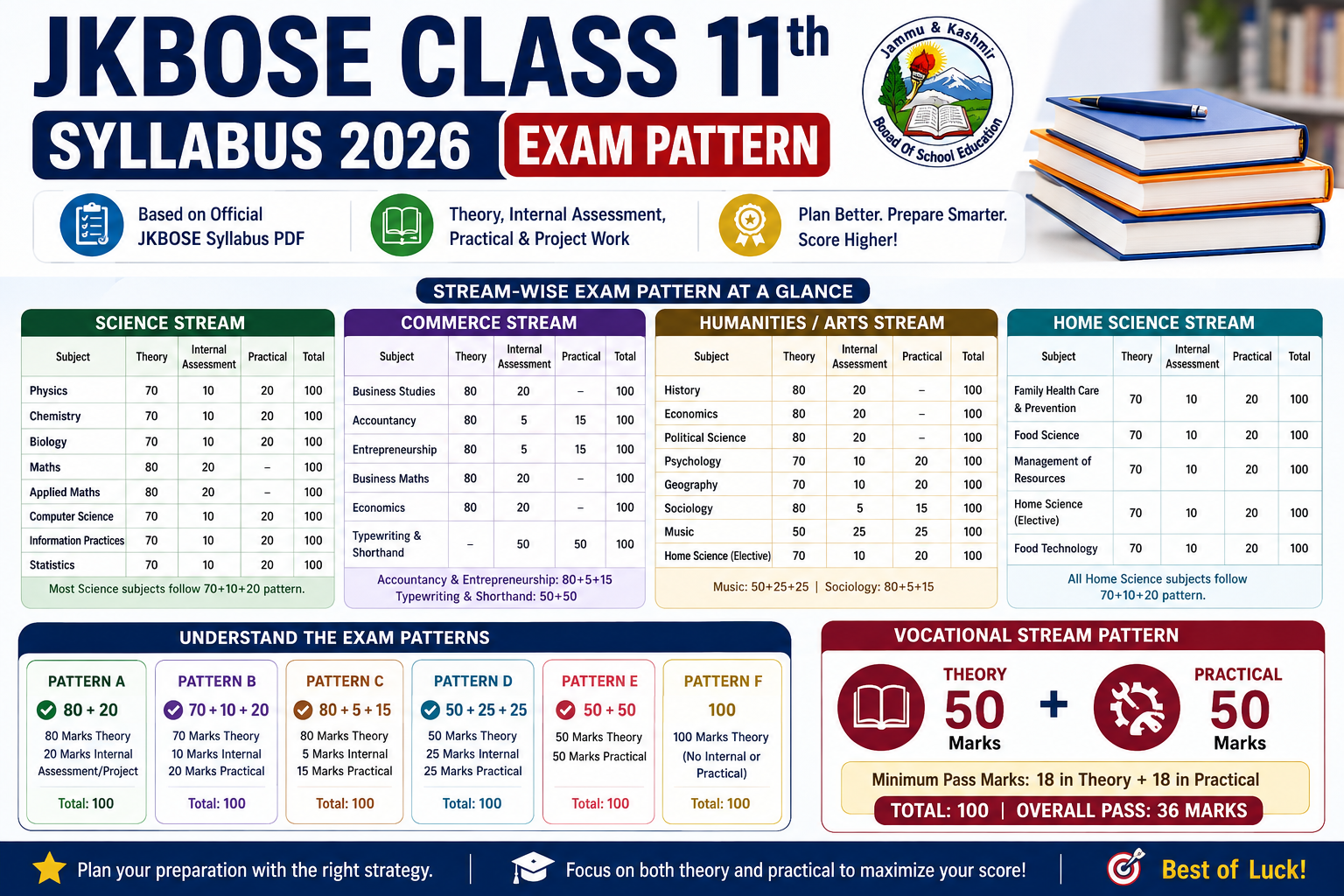
JKBOSE Class 11th Exam Pattern 2026 – At a Glance

The most important point for students is that all Class 11 subjects do not follow the same 100-mark pattern.

Depending on the subject, the assessment may be:

  • 80 marks Theory + 20 marks Internal Assessment
  • 70 marks Theory + 10 marks Internal Assessment + 20 marks External Practical
  • 80 marks Theory + 5 marks Internal + 15 marks External Practical
  • 50 marks Theory + 25 marks Internal + 25 marks Practical
  • 50 marks Theory + 50 marks Practical
  • 100 marks Theory

The official scheme lists these different patterns subject-wise.

JKBOSE Class 11th Scheme of Assessment 2026

1. General English

General English is compulsory and is common to all streams.

Component Maximum Marks Pass Marks
Theory 80 26
Internal Assessment 20 7
Total 100 33

The syllabus explicitly gives General English an 80+20 assessment pattern.

Science Stream Exam Pattern 2026

The JKBOSE Class 11 Science faculty includes Physics and Chemistry as compulsory subjects, with options including Mathematics, Applied Mathematics, Biology, Statistics, Geography, Geology, Biotechnology, Microbiology, Biochemistry, Computer Science, Information Practices, Environmental Science, Electronics and Food Technology.

JKBOSE Class 9th English Exam Pattern 2026

English follows a term-wise assessment system. Each term carries 40 marks external assessment and 10 marks internal assessment, while the prescribed Listening and Speaking/LSRW assessment contributes to the overall internal component.

Table 3: English Term I Theory Pattern

Section Component Marks
A Reading Comprehension 10
B Grammar 5
C Writing Skills 10
D Literature 15
Total External   40
Internal Assessment Listening & Speaking/LSRW 10
Term I Total   50

The same broad 40-mark external + 10-mark internal structure is followed for Term II.

Table 4: English Overall Marks

Component Term I Term II Total
External/ Written 40 40 80
Internal 10 10 20
Total 50 50 100

Science Stream – Subject-Wise Marks Distribution

Subject Theory Internal Assessment External Practical Total
Physics 70 10 20 100
Chemistry 70 10 20 100
Biology 70 10 20 100
Biotechnology 70 10 20 100
Microbiology 70 10 20 100
Biochemistry 70 10 20 100
Geography 70 10 20 100
Geology 70 10 20 100
Statistics 70 10 20 100
Environmental Science 70 10 20 100
Information Practices 70 10 20 100
Computer Science 70 10 20 100
Electronics 70 10 20 100
Food Technology 70 10 20 100
Mathematics 80 20 100
Applied Mathematics 80 20 100

Physics Exam Pattern

Component Marks
Theory 70
Internal Assessment 10
External Practical 20
Total 100

Minimum marks shown in the scheme: 25 in theory, 4 in internal assessment and 7 in external practical.

Physics Weightage

  • Theory: 70%
  • Internal Assessment: 10%
  • Practical: 20%

Chemistry Exam Pattern

Component Marks
Theory 70
Internal Assessment 10
External Practical 20
Total 100

Chemistry follows the same assessment pattern as Physics.

Biology Exam Pattern

Component Marks
Theory 70
Internal Assessment 10
External Practical 20
Total 100

Biology also follows the 70% theory + 10% internal + 20% external practical structure.

Mathematics Exam Pattern

Mathematics is different from Physics, Chemistry and Biology.

Component Marks
Theory 80
Internal Assessment/Project Work 20
Practical
Total 100

The official scheme lists Mathematics with 80 theory marks and 20 internal assessment marks.

Information Practices Exam Pattern

Component Marks
Theory 70
Internal Assessment 10
External Practical 20
Total 100

The detailed IP syllabus also explicitly states 70 theory + 30 practical, with 20 external and 10 internal marks.

Commerce Stream Exam Pattern 2026

The Commerce faculty includes General English, Business Studies and Accountancy as compulsory subjects, with Entrepreneurship or Economics, Business Mathematics and several other options.

Commerce Stream – Complete Marks Distribution

Subject Theory Internal Assessment External Practical Total
Business Studies 80 20 100
Accountancy 80 5 15 100
Entrepreneurship 80 5 15 100
Business Mathematics 80 20 100
Economics 80 20 100
Public Administration 80 20 100
General English 80 20 100
Typewriting & Shorthand 50 50 100

The assessment table specifically lists Business Studies as 80+20, Accountancy and Entrepreneurship as 80+5+15, Business Mathematics as 80+20, and Typewriting & Shorthand as 50+50.

Business Studies Exam Pattern

Component Marks
Theory 80
Project Work/Internal Assessment 20
Practical
Total 100

Business Studies Theory Paper

Section Question Type Marks
A Objective/MCQs 8
B Short Answer 12
C Short Answer 20
D Long Answer 24
E Long Answer 16
Total   80

The official syllabus specifies five sections and an 80-mark theory paper.


Accountancy Exam Pattern

Component Marks
Theory 80
Internal Assessment 5
External Practical 15
Total 100

Accountancy therefore has 20 marks beyond the theory paper, divided between internal and external assessment.

Entrepreneurship Exam Pattern

Component Marks
Theory 80
Internal Assessment 5
External Practical 15
Total 100

Business Mathematics Exam Pattern

Component Marks
Theory 80
Internal Assessment 20
Practical
Total 100

Humanities / Arts Stream Exam Pattern 2026

  • The Humanities faculty offers a wide range of subjects including languages, Economics, Mathematics, Applied Mathematics, Sociology, Psychology, Music, Geography, Philosophy, Education, History, Home Science, Public Administration, Statistics and Political Science.

Humanities – Subject-Wise Exam Pattern

Subject Theory Internal External Practical Total
History 80 20 100
Economics 80 20 100
Political Science 80 20 100
Education 80 20 100
Philosophy 80 20 100
Hindi 80 20 100
Urdu 80 20 100
Dogri 80 20 100
Kashmiri 80 20 100
Punjabi 80 20 100
Sanskrit 80 20 100
Arabic 80 20 100
Persian 80 20 100
English Literature 80 20 100
Buddhist Studies 80 20 100
Islamic Studies 80 20 100
Vedic Studies 80 20 100
Public Administration 80 20 100
Psychology 70 10 20 100
Geography 70 10 20 100
Sociology 80 5 15 100
Home Science (Elective) 70 10 20 100
Music 50 25 25 100
Bhoti 100 100

These distributions are taken from the subject-wise assessment table in the uploaded syllabus.

History Exam Pattern

Component Marks
Theory 80
Internal/Project Work 20
Practical
Total 100

History therefore belongs to the 80+20 pattern.

Economics Exam Pattern

Economics is offered in both Humanities and Commerce.

Component Marks
Theory 80
Internal/Project Work 20
Practical
Total 100

Political Science Exam Pattern

Component Marks
Theory 80
Internal Assessment/Project Work 20
Practical
Total 100

Psychology Exam Pattern

Psychology has a practical component.

Component Marks
Theory 70
Internal Assessment 10
External Practical 20
Total 100

The official scheme shows a minimum of 25 marks in theory, 4 in internal assessment and 7 in external practical.

Sociology Exam Pattern

Sociology has a different practical distribution.

Component Marks
Theory 80
Internal Assessment 5
External Practical 15
Total 100

Music Exam Pattern

Music is one of the subjects with a three-part assessment structure.

Component Marks
Theory 50
Internal Assessment 25
External Practical 25
Total 100

The uploaded scheme lists Music with 50 theory, 25 internal and 25 external practical marks.

Home Science Stream Exam Pattern 2026

The Home Science faculty has Family Health Care & Prevention, Food Science and Management of Resources as compulsory subjects, with other optional subjects including Computer Science, Information Practices, Environmental Science, Physical Education, Food Technology and vocational courses.

Home Science – Subject-Wise Assessment

Subject Theory Internal External Practical Total
Family Health Care & Prevention 70 10 20 100
Food Science 70 10 20 100
Management of Resources 70 10 20 100
Home Science (Elective) 70 10 20 100
Food Technology 70 10 20 100

The official table confirms the 70+10+20 structure for these Home Science subjects.

Physical Education Exam Pattern

Physical Education is available across streams.

Component Marks
Theory 70
Internal Assessment 10
External Practical 20
Total 100

The assessment table lists Physical Education under all streams with the 70+10+20 pattern.

Travel, Tourism & Hotel Management

Travel, Tourism and Hotel Management is listed for Arts, Home Science and Commerce.

Component Marks
Theory 100
Internal Assessment
External Practical
Total 100

The subject-wise assessment table lists it as a 100-mark subject with 36 marks as the overall pass requirement.

Vocational Stream Exam Pattern 2026

JKBOSE Class 11 vocational subjects have a completely different assessment system.

The vocational scheme includes subjects such as:

  • IT & ITes
  • Retail
  • Healthcare
  • Tourism & Hospitality
  • Security
  • Agriculture
  • Telecommunication
  • Media & Entertainment
  • Beauty & Wellness
  • Physical Education & Sports
  • Automotive
  • Apparel, Made-ups & Home Furnishing
  • Electronics & Hardware
  • Plumbing
  • Power

These vocational subjects are listed separately in the Class 11 syllabus.

Vocational Assessment Pattern

Component Maximum Marks Minimum Pass Marks Conducted By
Theory/Written Test 50 18 JKBOSE
Practical Test 50 18 School Level
Total 100 36

The practical component can include artifacts, demonstrations, projects, portfolios, written tests, viva voce and student participation.

Vocational Marks in Percentage

Component Weightage
Theory 50%
Practical 50%
Total 100%

This makes vocational subjects significantly different from conventional academic subjects.

All Major JKBOSE Class 11 Exam Patterns in One Table

Assessment Pattern Theory Internal External Practical Total
Pattern A 80 20 100
Pattern B 70 10 20 100
Pattern C 80 5 15 100
Pattern D 50 25 25 100
Pattern E 50 50 100
Pattern F 100 100

This table is useful for students because it shows why simply saying “Class 11 has a 100-mark paper” is not enough—the 100 marks are distributed differently according to the subject.

JKBOSE Class 11 Stream-Wise Quick Comparison

Stream Common Subjects/Examples Main Assessment Pattern
Science Physics, Chemistry, Biology 70 Theory + 10 Internal + 20 Practical
Science Mathematics, Applied Mathematics 80 Theory + 20 Internal
Commerce Business Studies 80 Theory + 20 Internal/Project
Commerce Accountancy, Entrepreneurship 80 Theory + 5 Internal + 15 Practical
Commerce Business Mathematics 80 Theory + 20 Internal
Humanities History, Economics, Political Science 80 Theory + 20 Internal
Humanities Psychology, Geography 70 Theory + 10 Internal + 20 Practical
Humanities Sociology 80 Theory + 5 Internal + 15 Practical
Humanities Music 50 Theory + 25 Internal + 25 Practical
Home Science Family Health Care, Food Science, Management of Resources 70 Theory + 10 Internal + 20 Practical
Vocational IT, Retail, Healthcare, Agriculture etc. 50 Theory + 50 Practical

Minimum Passing Marks in JKBOSE Class 11

The uploaded scheme generally provides an overall minimum passing requirement of 36 marks out of 100 for the listed subjects, with individual minimum requirements for theory, internal and practical components wherever applicable.

For vocational subjects, the requirement is particularly clear:

  • Theory: minimum 18/50
  • Practical: minimum 18/50
  • Overall: minimum 36/100

Why Students Should Understand the JKBOSE Class 11 Marks Distribution

Knowing the assessment pattern can help students plan their preparation more effectively.

For example, a Science student preparing for Physics should remember that only 70 marks come from theory, while 30 marks are connected with internal and practical assessment. Similarly, a Mathematics student has 80 theory marks and 20 internal marks, without an external practical component.

A Psychology student, meanwhile, has 70 theory + 10 internal + 20 external practical, while a Music student has an equal 25-mark internal and practical component in addition to 50 theory marks.

Therefore, students should not focus exclusively on the final written examination.

JKBOSE Class 11 Syllabus 2026: Subject List

Languages: General English, Hindi, Urdu, Bhoti, Dogri, Kashmiri, Punjabi, Sanskrit, Arabic, Persian and others.

Humanities: History, Economics, Geography, Political Science, Psychology, Sociology, Philosophy, Education, Public Administration and English Literature.

Science: Physics, Chemistry, Biology, Mathematics, Applied Mathematics, Statistics, Geology, Biotechnology, Microbiology, Biochemistry, Electronics, Computer Science, Information Practices and Environmental Science.

Commerce: Business Studies, Accountancy, Entrepreneurship, Economics, Business Mathematics, Public Administration and Typewriting & Shorthand.

Home Science: Family Health Care & Prevention, Food Science, Management of Resources and Home Science Elective.

Vocational: IT & ITes, Retail, Healthcare, Tourism & Hospitality, Security, Agriculture, Telecommunication, Media & Entertainment, Beauty & Wellness, Automotive, Electronics & Hardware, Plumbing, Power and others.

Frequently Asked Questions

What is the JKBOSE Class 11 exam pattern for 2026?

There is no single exam pattern for every subject. Depending on the subject, JKBOSE uses 80+20, 70+10+20, 80+5+15, 50+25+25, 50+50 and 100-mark theory structures.

How many marks are Physics, Chemistry and Biology?

Physics, Chemistry and Biology each have 70 theory marks, 10 internal assessment marks and 20 external practical marks, making 100 marks.

How many marks are there in Class 11 Mathematics?

Mathematics has 80 theory marks and 20 internal assessment marks.

What is the Business Studies exam pattern?

Business Studies has 80 marks theory and 20 marks project/internal assessment.

What is the vocational Class 11 exam pattern?

Vocational subjects have 50 marks theory and 50 marks practical, with a minimum of 18 marks required in each component and 36 marks overall.

Can a student choose Computer Science?

Yes. Computer Science is listed as an Additional/Optional Non-Vocational Subject and is also available as a CWSN alternative course.

JKBOSE Class 9th Syllabus 2026, JKBOSE 9th Exam Pattern 2026, JKBOSE Class 9 Marks Distribution, JKBOSE 9th Practical Marks, JKBOSE Class 9 Theory Marks, JKBOSE 9th Syllabus PDF : JKBOSE 9th Internal Assessment 2026, JKBOSE Class 9 Science Marks, JKBOSE Class 9 Maths Marks, JKBOSE 9th Computer Science Marks, JKBOSE 9th Painting Marks, JKBOSE 10th Music Marks, JKBOSE 9th Home Science Marks

Author Profile

thebijliengineer
thebijliengineer
The Bijli Engineer is an education and career content writer contributing to JammuKashmirInfo.com, with a focus on Jammu & Kashmir education, government jobs, competitive examinations, and student guidance.

Leave a Comment

Your email address will not be published. Required fields are marked *

Scroll to Top