Blog · JKBOSE · Class 9
JKBOSE Class 9th Syllabus 2026: Exam Pattern, Marks Distribution, Theory, Practical & Internal Assessment
A complete subject-by-subject breakdown of the updated JKBOSE Class 9 Syllabus and Assessment Scheme 2026 — theory marks, internal assessment, practical weightage and optional subjects, explained clearly for students and parents.
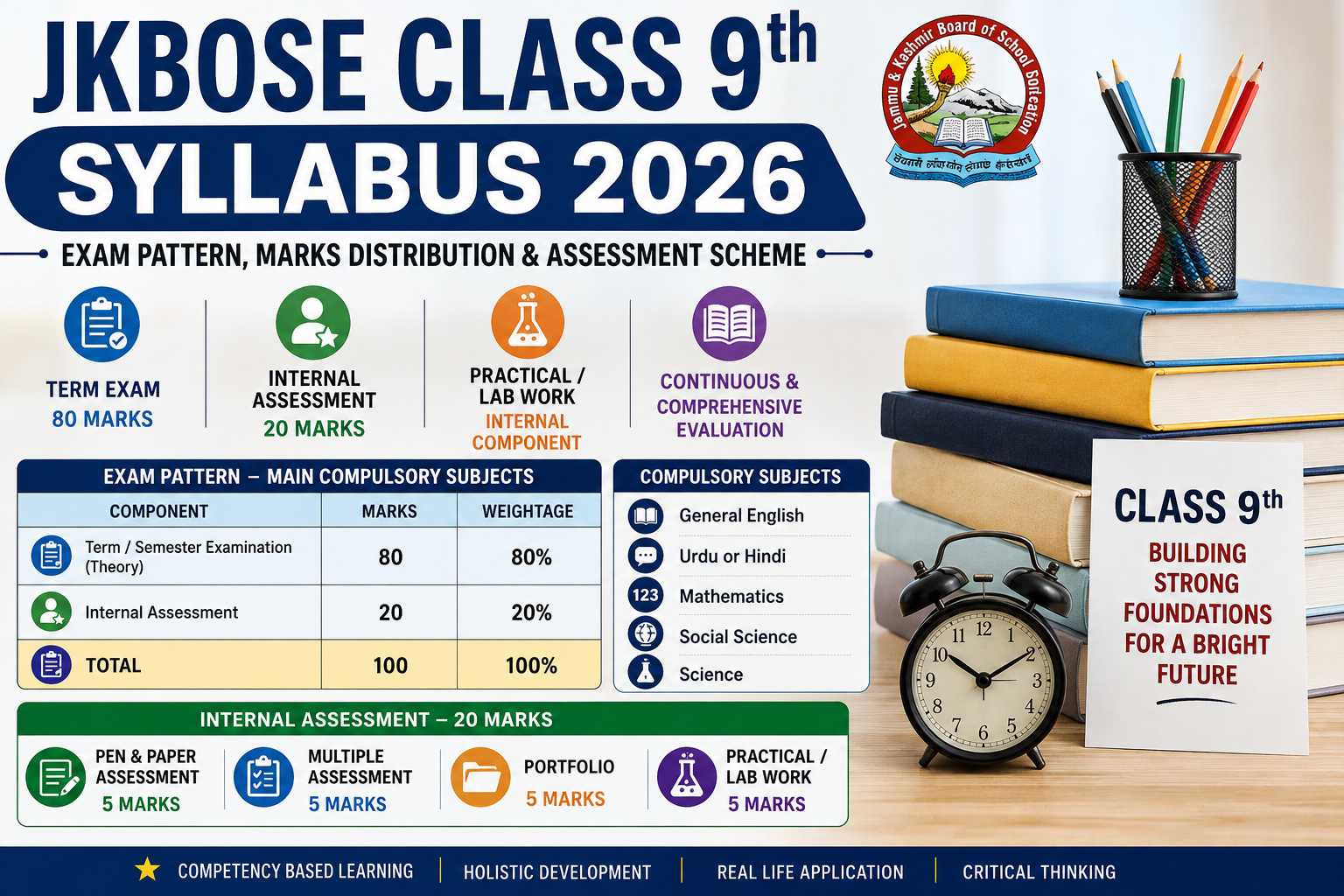
The Jammu and Kashmir Board of School Education (JKBOSE) has released the updated Class 9th Syllabus and Assessment Scheme 2026, covering compulsory subjects, additional languages, optional subjects, activity-related areas and alternative subjects for Children with Special Needs (CWSN).
This guide walks through the JKBOSE Class 9th Exam Pattern 2026 subject by subject — theory marks, internal assessment, practical/laboratory work, portfolio and periodic assessment.
JKBOSE Class 9th Subjects 2026
Every Class 9 student takes the following five compulsory subjects:
- General English
- Urdu or Hindi
- Mathematics
- Social Science
- Science
Social Science includes History, Political Science, Geography, Economics, Disaster Management and Road Safety Education. Science includes Physics, Chemistry and Biology.
Students may additionally choose one language from Urdu, Kashmiri, Arabic, Persian, Hindi, Dogri, Sanskrit, Bhoti and Punjabi — a compulsory language cannot be repeated as the additional choice.
The board also offers Vocational Subjects and Computer Science as options, while Work Experience, Health & Physical Education and Art Education are activity-related areas. CWSN students have additional alternative-course options: Painting, Music, Art and Drawing, Home Science and Computer Science.
Overall Exam Pattern 2026
The compulsory/main subjects carry 100 marks in total — 80 marks for Term/Semester Examination and 20 marks for Internal Assessment.
Table 1 — Overall assessment pattern
| Component | Marks | Weightage |
|---|---|---|
| Term / Semester Examination | 80 | 80% |
| Internal Assessment | 20 | 20% |
| Total | 100 | 100% |
The 80 external marks are split across Term I and Term II — generally 40 marks per term for the compulsory subjects — while the internal component carries 20 marks.
Internal Assessment — 20 Marks
JKBOSE’s 20-mark internal assessment for the main compulsory subjects consists of periodic assessment, portfolio and practical/laboratory work.
Table 2 — Internal assessment breakup
| Component | Marks |
|---|---|
| Pen & Paper Assessment | 5 |
| Multiple Assessment | 5 |
| Portfolio | 5 |
| Practical / Laboratory Work | 5 |
| Total | 20 |
Periodic assessment carries 10 marks, split equally between Pen & Paper Assessment and Multiple Assessment. Multiple Assessment can include quizzes, oral tests, class discussions, field work and concept maps.
English Exam Pattern
English follows a term-wise system: each term carries 40 marks external assessment and 10 marks internal assessment, with Listening and Speaking/LSRW feeding into the internal component.
Table 3 — English, Term I theory
| Section | Component | Marks |
|---|---|---|
| A | Reading Comprehension | 10 |
| B | Grammar | 5 |
| C | Writing Skills | 10 |
| D | Literature | 15 |
| Total External | 40 | |
| Internal — Listening & Speaking/LSRW | 10 | |
| Term I Total | 50 | |
The same 40-mark external + 10-mark internal structure applies to Term II.
Table 4 — English, overall marks
| Component | Term I | Term II | Total |
|---|---|---|---|
| External / Written | 40 | 40 | 80 |
| Internal | 10 | 10 | 20 |
| Total | 50 | 50 | 100 |
Mathematics Exam Pattern
Mathematics carries 80 marks external examination and 20 marks internal assessment, with the syllabus split between Term I and Term II.
Table 5 — Term-wise theory marks
| Term | Theory Marks |
|---|---|
| Term I | 40 |
| Term II | 40 |
| Total Theory | 80 |
Table 6 — Internal assessment
| Component | Marks |
|---|---|
| Pen Paper Test | 5 |
| Multiple Assessment | 5 |
| Portfolio | 5 |
| Lab Practical / Activities | 5 |
| Total Internal | 20 |
| Grand Total | 100 |
The question-paper design assigns roughly 54% weightage to remembering and understanding, 24% to applying knowledge, and 22% to analysing, evaluating and creating.
Science Exam Pattern
Science is divided into Physics, Chemistry and Biology, with an 80-mark term/semester examination and a 20-mark internal assessment.
Table 8 — Theory marks per term
| Section | Subject | Marks per Term |
|---|---|---|
| Section I | Physics | 13 |
| Section II | Chemistry | 13 |
| Section III | Biology | 14 |
| Total (Science) | 40 | |
With two term examinations, the total theory component comes to 80 marks.
Table 9 — Question paper pattern
| Question Type | Number / Pattern | Marks |
|---|---|---|
| Long Answer | 3 × 5 | 15 |
| Short Answer | 3 × 3 | 9 |
| Very Short Answer | 3 × 2 | 6 |
| MCQs | 10 × 1 | 10 |
| Total | 40 | |
Table 10 — Overall assessment
| Component | Marks |
|---|---|
| Theory — Term I | 40 |
| Theory — Term II | 40 |
| Internal Assessment | 20 |
| Total | 100 |
The syllabus also prescribes practical/project/assignment activities across Physics, Chemistry and Biology.
Language Subjects
Besides General English and the compulsory Urdu/Hindi choice, students may pick one additional language.
Table 11 — Additional / optional languages
| Category | Languages |
|---|---|
| Additional / Optional | Urdu |
| Kashmiri | |
| Arabic | |
| Persian | |
| Hindi | |
| Dogri | |
| Sanskrit | |
| Bhoti | |
| Punjabi |
A compulsory language cannot be repeated as the additional choice. For the main compulsory subjects, the general framework is 80 marks external + 20 marks internal — individual languages may have their own detailed paper design, so students should check the subject-specific section of the syllabus.
Computer Science
Computer Science is listed as an Additional/Optional Subject (Non-Vocational), and is also available as a CWSN alternative course.
Table 12 — Computer Science
| Category | Status |
|---|---|
| Subject Type | Additional/Optional — Non-Vocational |
| Available as CWSN Alternative | Yes |
| Detailed syllabus | Pages 48–52 of the uploaded document |
| Theory/Practical breakup | Refer to subject-specific scheme in the PDF |
Activity-Related Areas
Work Experience, Health & Physical Education and Art Education are each assessed by the teacher continuously through the academic session rather than by a single written paper.
Table 13–15 — Activity-related areas
| Subject | Assessment | Marks |
|---|---|---|
| Work Experience | Continuous Teacher Evaluation | 100 |
| Health & Physical Education | Continuous Teacher Evaluation | 100 |
| Art Education | Continuous Teacher Evaluation | 100 |
Work Experience includes practical/vocational activities and in-and-out-of-school projects. Health & Physical Education covers personal and environmental health, food and nutrition, first aid, athletics, games, gymnastics and yoga. Art Education covers two- and three-dimensional/sculptural activities, assignments, group work and theoretical understanding of art and culture.
Painting, Music, Home Science and Art & Drawing
These subjects appear in the CWSN alternative-course list. A CWSN candidate can choose either Painting or Art and Drawing, not both.
Table 16 — CWSN alternative subjects
| Subject | Available as Alternative Course |
|---|---|
| Painting | Yes |
| Music | Yes |
| Art & Drawing | Yes |
| Home Science | Yes |
| Computer Science | Yes |
Quick Comparison — Major Subjects
Table 17 — At a glance
| Subject | Theory/External | Internal | Total |
|---|---|---|---|
| General English | 80 | 20 | 100 |
| Hindi/Urdu* | 80 | 20 | 100 |
| Mathematics | 80 | 20 | 100 |
| Social Science | 80 | 20 | 100 |
| Science | 80 | 20 | 100 |
| Work Experience | — | Continuous evaluation | 100 |
| Health & Physical Education | — | Continuous evaluation | 100 |
| Art Education | — | Continuous evaluation | 100 |
*Follow the detailed language-specific assessment design for the selected language.
Is There a Practical Exam in Class 9?
Yes — the role of practical/laboratory work depends on the subject.
For the main compulsory subjects, the 20-mark internal assessment includes 5 marks for practical/laboratory work, one of three broad internal-assessment components the board specifies.
For Mathematics, the syllabus explicitly lists lab practical activities from the prescribed books as part of the 20-mark internal assessment. Science includes a substantial list of prescribed practical/project/assignment activities across Physics, Chemistry and Biology.
What students should maintain
Internal assessment is meant to be continuous rather than a single exam, with an emphasis on competency-based assessment, critical thinking, analysis, interpretation and conceptual understanding. Students should keep:
- Test records / notebooks
- Portfolio work
- Practical/laboratory records
- Project work
- Assignments and other subject-specific activities
The portfolio is meant to show a student’s work, progress, growth and accomplishments over time.
Key Points to Remember
- Five subjects are compulsory: English, Urdu/Hindi, Mathematics, Social Science and Science.
- Main compulsory subjects generally follow an 80 marks external + 20 marks internal structure.
- Internal assessment includes periodic assessment, portfolio and practical/laboratory work.
- Mathematics has 40 marks in Term I and 40 marks in Term II.
- Science theory is divided into Physics, Chemistry and Biology sections.
- Social Science includes History, Geography, Political Science, Economics, Disaster Management and Road Safety Education.
- Work Experience, Health & Physical Education and Art Education are assessed through the academic session, not a conventional written paper.
- Students can select additional languages and optional subjects per the scheme of studies.
Frequently Asked Questions
What is the total marks for JKBOSE Class 9th?
For the main compulsory subjects, the framework is 100 marks — 80 for Term/Semester Examination and 20 for Internal Assessment.
How many marks are allotted to internal assessment?
The main compulsory subjects carry 20 marks for Internal Assessment.
How are the 20 internal marks divided?
5 marks Pen & Paper Assessment, 5 marks Multiple Assessment, 5 marks Portfolio and 5 marks Practical/Laboratory Work.
Is Science practical included in Class 9?
Yes — the Science syllabus includes practical/project/assignment activities in Physics, Chemistry and Biology.
Does Class 9 have Science, Commerce and Arts streams?
No. The syllabus does not divide Class 9 into Classes 11–12 style streams — it provides compulsory subjects, additional languages, optional subjects and activity-related areas instead.
Can a student choose Computer Science?
Yes — it is listed as an Additional/Optional Non-Vocational subject, and is also available as a CWSN alternative course.
Which subjects are compulsory in Class 9?
General English, Urdu or Hindi, Mathematics, Social Science and Science.
Final Words
The JKBOSE Class 9th Syllabus 2026 follows a more continuous, competency-based assessment approach, combining term examinations with school-based internal assessment. For the main compulsory subjects, students should prepare for 80 marks of external assessment and 20 marks of internal assessment — giving equal attention to tests, activities, portfolio work and practical/laboratory activities.
Class 9 is not divided into Science, Commerce and Arts streams. Instead, the board provides a common set of compulsory subjects along with additional language, optional and activity-related choices.

thebijliengineer
Education and career content writer contributing to JammuKashmirInfo.com, with a focus on Jammu & Kashmir education, government jobs, competitive examinations and student guidance.
Author Profile
- The Bijli Engineer is an education and career content writer contributing to JammuKashmirInfo.com, with a focus on Jammu & Kashmir education, government jobs, competitive examinations, and student guidance.
Latest entries
 BlogSeptember 1, 2026JKSSB Class IV Recruitment 2026 Notification Out, Apply Online For 2863 Vacancies
- BlogAugust 21, 2026lesson
 BlogAugust 17, 2026JK STUDY BUDDY CLASS 7 WEEKLY QUIZ SUBJECT SST
- BlogAugust 17, 2026JK STUDY BUDDY CLASS 7 WEEKLY QUIZ SUBJECT MATH
Social Science Exam Pattern
Social Science carries 80 marks for theory and 20 marks for internal assessment.
Table 7 — Marks distribution
The question paper also assigns 5 marks to map skills, with the remainder assessing remembering/understanding, application and higher-order competencies.
Social Science internal / project work
Road Safety Education includes project work worth 5 marks within the internal assessment: