JammuKashmirInfo

jktet

Blog, jktet

Books for Jammu Kashmir Teacher Eligibility Test (JKTET) for In-Service Teachers

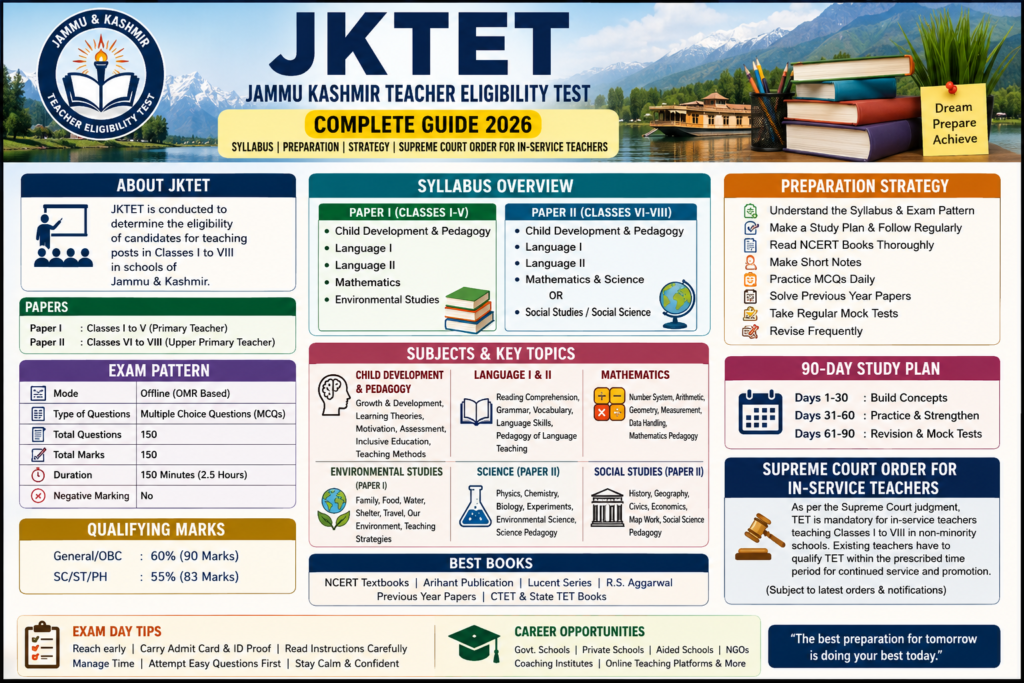
Books for Jammu Kashmir Teacher Eligibility Test (JKTET) for In-Service Teachers Disclaimer: This section is based on the Supreme Court’s judgment regarding the applicability of the Teacher Eligibility Test (TET) to in-service teachers and subsequent developments in Jammu & Kashmir. Teachers should always refer to the latest orders of the Supreme Court and the Government of Jammu & Kashmir, as legal proceedings and implementation timelines may change. Introduction The issue of the Teacher Eligibility Test (TET) for in-service teachers has become one of the most significant developments in school education across India. A landmark judgment of the Supreme Court of India clarified that the requirement of passing the Teacher Eligibility Test (TET) is not confined only to newly recruited teachers but also extends, subject to the Court’s directions, to many teachers who were appointed before TET became mandatory under the NCTE framework. The judgment has major implications for thousands of serving teachers in Jammu & Kashmir, particularly those teaching Classes I to VIII in non-minority schools. Following the judgment, the Union Territory administration initiated steps for conducting JKTET, while also seeking legal relief through review proceedings. (School Education Jammu and Kashmir) Background of the Supreme Court Judgment The National Council for Teacher Education (NCTE) introduced the Teacher Eligibility Test (TET) as the minimum professional qualification for teachers teaching Classes I to VIII under the Right of Children to Free and Compulsory Education Act, 2009 (RTE Act). For many years, different states interpreted the applicability of TET differently, especially for teachers who had already entered service before TET became compulsory. To settle this issue, the Supreme Court held that the requirement of TET applies to eligible in-service teachers covered by the judgment and that merely being appointed before the introduction of TET does not automatically exempt a teacher from meeting the qualification requirement. Why Was This Judgment Significant? The judgment emphasized that: Applicability to Jammu & Kashmir Following the judgment, the Government of Jammu & Kashmir began the process of implementing the directions by designating JKBOSE/SSSA as the nodal agency for conducting JKTET. Later administrative developments, including keeping certain implementation orders in abeyance and pursuing legal remedies, also took place. (School Education Jammu and Kashmir) The Education Department also filed a review petition before the Supreme Court seeking relief for affected teachers after the Court dismissed earlier review petitions while extending the compliance timeline. Key Directions Emerging from the Supreme Court Judgment The Supreme Court’s decision has been widely reported as laying down the following principles: 1. TET is Mandatory Teachers covered by the judgment who teach Classes I to VIII are required to possess or acquire TET qualification within the period allowed by the Court. 2. Existing Teachers Are Not Automatically Exempt Appointment before the introduction of TET does not, by itself, exempt a teacher from the requirement where the Court has directed compliance. 3. Promotion May Be Affected The judgment indicates that teachers who are exempt from immediate removal because they are close to retirement may still not be eligible for promotion unless they obtain the prescribed TET qualification. 4. Compliance Timeline Subsequent proceedings extended the deadline for affected teachers to qualify TET beyond the original period, although implementation remains subject to ongoing legal developments. JKTET Exam Pattern Understanding the examination pattern is crucial before beginning preparation. The JKTET examination consists entirely of objective-type multiple-choice questions (MCQs). There is generally one mark for each correct answer, and candidates are required to choose the most appropriate option from the choices provided. Paper I Exam Pattern Subject Questions Marks Child Development & Pedagogy 30 30 Language I 30 30 Language II 30 30 Mathematics 30 30 Environmental Studies 30 30 Total 150 150 Paper II Exam Pattern Subject Questions Marks Child Development & Pedagogy 30 30 Language I 30 30 Language II 30 30 Mathematics & Science (for Mathematics/Science teachers) or Social Studies (for Social Science teachers) 60 60 Total 150 150 Duration of Examination The examination duration is generally: 2 Hours 30 Minutes (150 Minutes) Candidates should develop effective time management skills to complete all questions within the allotted time. Mode of Examination JKTET is typically conducted as an offline examination using OMR sheets, where candidates mark their responses with a blue or black ballpoint pen. The mode of examination is specified in the official notification and should be verified before the exam. Is There Negative Marking? According to the prevailing JKTET pattern, there is generally no negative marking for incorrect answers. This allows candidates to attempt all questions strategically, even if they need to make educated guesses. Minimum Qualifying Marks To qualify for JKTET, candidates must secure the minimum percentage of marks prescribed in the official notification. The qualifying standard may vary depending on the candidate’s category and applicable government rules. Qualifying JKTET awards an eligibility certificate but does not guarantee appointment. Candidates must still participate in teacher recruitment processes conducted by the competent authorities. Understanding the JKTET Syllabus Before purchasing books or starting your preparation, it is essential to understand the syllabus thoroughly. The JKTET syllabus is based on the curriculum prescribed by the National Council for Teacher Education (NCTE) and focuses on assessing a candidate’s teaching aptitude, pedagogical understanding, and subject knowledge. The syllabus is divided into two papers: Paper I (Classes I–V) Designed for candidates who wish to become Primary School Teachers. It includes five sections: Paper II (Classes VI–VIII) Designed for candidates aspiring to teach Upper Primary Classes. It includes: OR JKTET Child Development & Pedagogy Syllabus This section is considered the heart of the examination because it evaluates your understanding of how children learn and develop. Important Topics Child Development Learning Process Inclusive Education Assessment Teaching Methods Best Books for Child Development & Pedagogy 1. Child Development & Pedagogy – Arihant Publications One of the most recommended books with previous year questions and practice sets. 2. Child Development & Pedagogy – Pearson Ideal for conceptual understanding. 3. CTET & TET Child Development – Disha Publications Useful for practicing objective questions. Language I Syllabus

Blog, jktet

Books for Jammu Kashmir Teacher Eligibility Test (JKTET)

Books for Jammu Kashmir Teacher Eligibility Test (JKTET) Jammu Kashmir Teacher Eligibility Test. JKTET 2026, JK TET Exam, JKTET Eligibility, JKTET Exam Pattern, JKTET Preparation, JK Teacher RecruitmentJammu Kashmir Teacher Eligibility Test (JKTET) 2026: Complete Guide, Eligibility, Exam Pattern & Preparation. Learn everything about the Jammu Kashmir Teacher Eligibility Test (JKTET), including eligibility, exam pattern, selection process, validity, preparation tips, and complete syllabus. Read this comprehensive guide to kickstart your teaching career. Jammu Kashmir Teacher Eligibility Test (JKTET): The Complete Guide for Aspiring Teachers Teaching is one of the most respected and rewarding professions in India. Every year, thousands of graduates and aspiring educators dream of securing a government teaching job in Jammu & Kashmir. The first and most important milestone in achieving this goal is qualifying the Jammu Kashmir Teacher Eligibility Test (JKTET). Whether you aspire to teach in primary schools (Classes I-V) or upper primary schools (Classes VI-VIII), qualifying the JKTET is an essential requirement for becoming eligible for teaching positions in government and many private schools. However, many aspirants struggle with questions such as: This comprehensive guide answers all these questions and provides a roadmap to crack the examination successfully. What is Jammu Kashmir Teacher Eligibility Test (JKTET)? The Jammu Kashmir Teacher Eligibility Test (JKTET) is a state-level eligibility examination conducted to determine whether candidates possess the minimum qualifications and teaching aptitude required for appointment as teachers in schools across Jammu & Kashmir. The examination follows the guidelines laid down by the National Council for Teacher Education (NCTE) and serves as a benchmark for assessing candidates’ pedagogical knowledge, subject understanding, and teaching competencies. Unlike recruitment examinations, JKTET does not directly provide employment. Instead, it certifies that a candidate is eligible to apply for teaching vacancies announced by recruiting authorities. In simple words, JKTET is an eligibility certificate—not a recruitment exam. Qualifying this examination significantly enhances a candidate’s prospects of securing teaching positions in government and recognized educational institutions. Why is JKTET Important? The teaching profession requires more than academic knowledge. Teachers must understand child psychology, classroom management, effective teaching methodologies, and subject-specific pedagogy. JKTET evaluates these competencies to ensure that qualified candidates can provide quality education aligned with modern educational standards. Some key reasons why JKTET is important include: Objectives of JKTET The examination has been designed with several educational objectives. These include: Ultimately, the goal is to provide competent teachers who can contribute to holistic student development. Who Conducts the JKTET Examination? The JKTET examination is conducted by the designated education authority of the Government of Jammu & Kashmir. The conducting authority releases the official notification containing information regarding: Candidates should regularly check the official notification for the latest updates related to the examination. Who Should Apply for JKTET? The examination is suitable for individuals who aspire to become teachers in government or recognized schools. The following candidates should consider appearing for JKTET: If your goal is to build a stable and respected career in teaching, JKTET is one of the first milestones. Types of JKTET Papers The examination consists of two separate papers. Paper I Paper I is intended for candidates who wish to teach: These are primary school teaching positions. Paper II Paper II is designed for candidates aspiring to teach: These are upper primary teaching positions. Both Papers Candidates interested in teaching from Classes I to VIII may appear for both papers, provided they satisfy the eligibility criteria for each. JKTET Eligibility Criteria One of the most frequently asked questions among aspirants concerns eligibility. While the detailed criteria are specified in the official notification, the broad requirements are as follows. Educational Qualification for Paper I Candidates should generally possess: or Educational Qualification for Paper II Candidates should generally have: or Important Note: Eligibility requirements may be revised from time to time in accordance with NCTE guidelines. Candidates should always refer to the latest official notification before applying. Is There Any Age Limit? Generally, candidates meeting the prescribed educational qualifications are eligible to apply. Specific age conditions, if any, are notified in the recruitment or examination advertisement. It is advisable to check the latest official notification for updated information regarding age eligibility. Is There Any Restriction on Number of Attempts? One of the biggest advantages of JKTET is that there is generally no restriction on the number of attempts for eligible candidates. Aspirants may reappear to improve their performance or qualify if unsuccessful in previous attempts, subject to the rules in force at the time of the examination. JKTET Exam Pattern Understanding the examination pattern is crucial before beginning preparation. The JKTET examination consists entirely of objective-type multiple-choice questions (MCQs). There is generally one mark for each correct answer, and candidates are required to choose the most appropriate option from the choices provided. Paper I Exam Pattern Subject Questions Marks Child Development & Pedagogy 30 30 Language I 30 30 Language II 30 30 Mathematics 30 30 Environmental Studies 30 30 Total 150 150 Paper II Exam Pattern Subject Questions Marks Child Development & Pedagogy 30 30 Language I 30 30 Language II 30 30 Mathematics & Science (for Mathematics/Science teachers) or Social Studies (for Social Science teachers) 60 60 Total 150 150 Duration of Examination The examination duration is generally: 2 Hours 30 Minutes (150 Minutes) Candidates should develop effective time management skills to complete all questions within the allotted time. Mode of Examination JKTET is typically conducted as an offline examination using OMR sheets, where candidates mark their responses with a blue or black ballpoint pen. The mode of examination is specified in the official notification and should be verified before the exam. Is There Negative Marking? According to the prevailing JKTET pattern, there is generally no negative marking for incorrect answers. This allows candidates to attempt all questions strategically, even if they need to make educated guesses. Minimum Qualifying Marks To qualify for JKTET, candidates must secure the minimum percentage of marks prescribed in the official notification. The qualifying standard may vary depending on the candidate’s category and applicable government

List Your BUSINESS Here for FREE

X
Scroll to Top