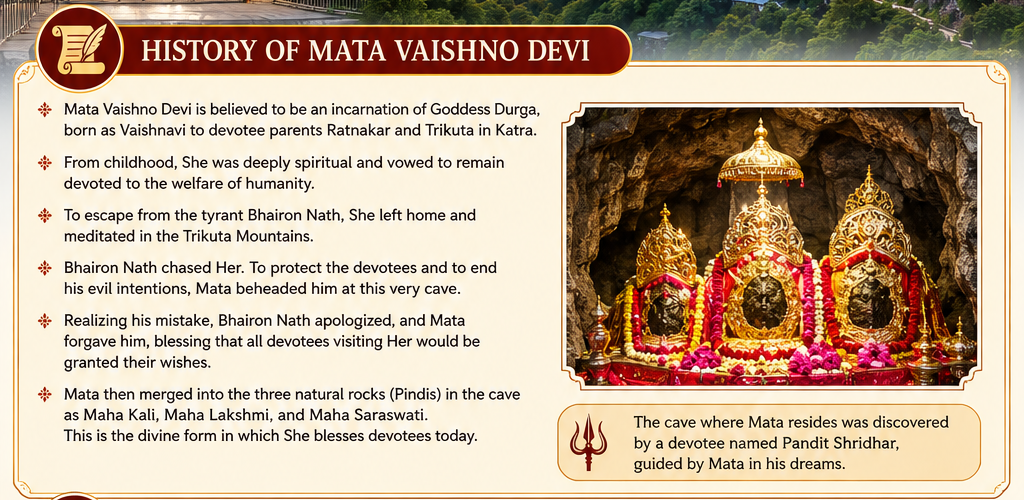
The Complete History and Spiritual Significance of Mata Vaishno Devi
Nestled at an altitude of 5,200 feet in the Trikuta Mountains of Jammu & Kashmir, the Shri Mata Vaishno Devi Shrine is one of the holiest Hindu pilgrimage sites in the world. Every year, more than 8 million devotees make the arduous trek through the Himalayan terrain to seek the blessings of Mata Vaishno Devi — a number that rivals the footfall of the world’s most celebrated religious destinations.
The shrine is not merely a place of worship. It is a living testament to an ancient legend, a journey of devotion, a geography steeped in divinity. To understand Mata Vaishno Devi is to understand the very soul of Shakti worship in India.
This post takes you through the complete history of Mata Vaishno Devi, the profound stories behind the Ardhkuwari Cave and the Bhairavnath Temple, and the deep spiritual significance that draws seekers from every corner of the world.
Who Is Mata Vaishno Devi? The Divine Origin
The name “Vaishno Devi” itself carries layered meaning. “Vaishnavi” refers to a devotee or form of Vishnu’s Shakti — the divine feminine energy associated with Lord Vishnu. “Devi” simply means Goddess. Together, she is understood to be the embodiment of Maha Kali, Maha Lakshmi, and Maha Saraswati — the Tridevi or the three supreme goddesses of Hinduism — unified in one form.
According to ancient Hindu scriptures, the Goddess did not merely reside in the mountains; she is the mountains. The Trikuta Hills are considered her eternal abode, and the three holy pindis (natural rock formations) inside the sanctum sanctorum of the cave are worshipped as her physical manifestation — not as idols made by human hands, but as swayambhu (self-manifested) sacred forms.
The Ancient Legend: The Birth of Vaishnavi
The origin story of Mata Vaishno Devi takes us back to an era long before recorded history, when the universe was engaged in a cosmic struggle between the forces of good and evil.
The Birth of the Goddess
According to the Puranas and local oral traditions, Ratnakar Sagar, a deeply devout Brahmin who lived on the southern coast of India, performed intense penance and tapasya (spiritual austerity) to receive the blessings of the divine Mother. His devotion moved Adi Shakti (the primal Goddess), and she chose to incarnate as his daughter.
The child was born with a radiant glow that lit up the room like a thousand suns. Even as an infant, she recited the names of Vishnu and was uninterested in the pleasures of ordinary life. Her father named her Vaishnavi, acknowledging her Vaishnava nature from birth.
The Divine Purpose
Vaishnavi grew up with extraordinary powers. From her early years, she was an ardent devotee of Lord Vishnu (Ram), meditating on him constantly. According to legend, she performed intense tapasya on the sea shore, and Lord Rama himself appeared before her during his search for Sita.
Recognizing her spiritual power and divine identity, Lord Rama told her: “After the completion of my mission on earth, I shall come to you and accept you as my devotee. Go to the Trikuta Hills in the north and meditate there. You will be known as Vaishno Devi, and the world will come to you.”
Vaishnavi accepted this as divine instruction and made her way to the Trikuta Mountains in what is today Jammu & Kashmir. She found a cave and began deep penance, waiting for Lord Rama to fulfill his promise.
After defeating Ravana, Lord Rama did visit her. He tested her powers and acknowledged her divine nature. He told her that since he had already taken the form of Ram and could not accept a second consort, she would instead be worshipped eternally in the cave. Her divine form would be enshrined in the rock itself — the three pindis representing Maha Kali, Maha Lakshmi, and Maha Saraswati.
The Story of Bhairavnath: The Demon Who Became a Devotee
No account of Vaishno Devi is complete without the legendary tale of Bhairavnath, which forms the dramatic climax of the goddess’s earthly story and explains a remarkable temple that stands at the very end of the pilgrimage route.
The Encounter
During Vaishnavi’s time in the Trikuta Hills, a powerful and fearsome tantric sage named Bhairavnath came to know of her presence. Bhairavnath had attained great spiritual powers through dark tantric practices, but his ego had made him arrogant and lustful for more power.
He became obsessed with capturing Vaishnavi and absorbing her divine energy to enhance his own powers. He pursued her relentlessly through the mountains.
The Chase Through the Mountains
The goddess, determined to complete her meditation and not engage in unnecessary conflict, fled from Bhairavnath through the hills. It was during this chase that several sacred spots along today’s pilgrimage route were formed.
When Vaishnavi needed to rest and hide, she took shelter in a narrow cave — a place so small that she had to bend and compress her body to enter and meditate inside. She remained in this cave for nine months, meditating deeply while Bhairavnath searched for her. This cave is the sacred Ardhkuwari Cave — one of the most spiritually significant stops on the pilgrimage.
The Final Battle at the Cave
Bhairavnath eventually tracked her to the main cave (today’s sanctum sanctorum). The goddess could no longer run. She transformed herself from a gentle sage-devotee into a warrior Goddess and turned to face her pursuer.
A fierce battle ensued. The Goddess slew Bhairavnath with her trishul (trident), severing his head. His head, according to legend, flew several kilometers and landed at a hilltop — the spot where today’s Bhairavnath Temple stands.
The Redemption of Bhairavnath
Here is where the story takes a beautiful, distinctly Hindu turn.
Even as his head landed on the hilltop, Bhairavnath realized his error. In his dying moments, his ego dissolved, and he became a true devotee. He prayed to the Goddess for forgiveness, recognizing her supreme divinity.
The Goddess, in her infinite compassion, forgave him. She blessed him with the boon that no pilgrimage to Vaishno Devi would be considered complete without a visit to the Bhairavnath Temple. This is why, to this day, pilgrims are advised to visit the Bhairavnath Temple after darshan at the main shrine — the pilgrimage is spiritually considered incomplete without it.
Ardhkuwari: The Womb Cave and Its Spiritual Meaning
Roughly midway on the 14-kilometre trek from Katra to the main shrine lies Ardhkuwari, one of the most revered spots in the entire pilgrimage.
The Meaning of the Name
“Ardhkuwari” translates to “half-virgin” or “half-way maiden.” There are two layers of meaning here:
- Geographical: It is located roughly halfway on the pilgrimage route.
- Mythological: It marks the cave where the goddess spent nine months in meditation, neither completing nor abandoning her tapasya — hence, the state of being “half-way” in her spiritual journey on earth.
The Garbh Joon Cave
The actual cave at Ardhkuwari is called Garbh Joon, meaning “the womb.” It is a narrow passage, barely wide enough for a person to squeeze through, stretching about 15 metres in length.
Pilgrims who pass through this cave are believed to symbolically return to the cosmic womb of the Mother Goddess and be spiritually reborn. Many devotees choose to crawl through the cave on their backs or stomachs as a form of spiritual surrender.
Why Ardhkuwari Is a Must-Visit
- It contains a small shrine dedicated to Mata Vaishno Devi herself, where she is worshipped in her form as a meditating goddess.
- There is also a temple of Hanuman ji nearby, signifying the protective divine force that accompanies every devotee on the journey.
- Pilgrims seeking healing, fertility, spiritual cleansing, or liberation from past karma specifically seek the blessings of the Garbh Joon cave.
- The cave is believed to grant the devotee a fresh spiritual start — a rebirth from the divine mother’s womb.
The Main Shrine: The Holy Cave and the Three Pindis
The ultimate destination of the pilgrimage is the Holy Cave (Shri Mata Vaishno Devi Ka Bhawan), located at 5,200 feet above sea level in the Trikuta Mountains.
Inside this cave, which is approximately 30 metres long, are the three naturally formed rock pinnacles known as pindis:
- Maha Kali Pindi — located on the left, representing the power of destruction, transformation, and liberation.
- Maha Lakshmi Pindi — in the centre, representing abundance, prosperity, and preservation.
- Maha Saraswati Pindi — on the right, representing knowledge, wisdom, and creative energy.
These are not carved idols. They are svayambhu — self-manifested. The pindis are draped in sacred cloth and decorated with flowers, but their core form remains untouched since time immemorial. A small, icy spring flows through the cave — the Charan Ganga — considered highly sacred. Pilgrims who bathe their feet in its waters are believed to be purified of all sins.
Historical Timeline: Rediscovery and Modern Pilgrimage
While the mythological history of Vaishno Devi is ancient, the shrine’s documented human history has its own fascinating journey.
- Ancient Period: The shrine is mentioned in various Puranic texts. Local Dogra communities of the region have venerated the cave for centuries as a sacred space.
- Medieval Period: The pilgrimage grew quietly under local tradition. The shrine gained prominence through wandering sadhus and saints who spread word of its divine energy.
- Colonial Period (19th–20th Century): The pilgrimage continued largely as a local affair, with pilgrims making the trek by foot through rugged mountain terrain.
- Post-Independence: With improved infrastructure in J&K, the pilgrimage began drawing larger numbers.
- 1986: The Shri Mata Vaishno Devi Shrine Board was constituted by the Government of Jammu & Kashmir to manage the shrine and improve pilgrim facilities. This was a watershed moment.
- 1990s–2000s: Major infrastructure development — helicopter services, ponies, battery-operated vehicles, proper trekking paths, RFID-based darshan tokens, rest houses, and medical facilities — transformed the pilgrimage experience.
- Today: Over 8 million pilgrims annually, making it the second most visited Hindu shrine in India after Tirupati Balaji.
Spiritual Significance of Mata Vaishno Devi
1. The Shakti Peeth Connection
Mata Vaishno Devi is considered one of the most important Shakti Peethas — sacred sites of the Divine Mother — in India. The three pindis are revered as her living, breathing presence.
2. Fulfillment of Desires (Manokamna Purti)
The Goddess is worshipped as Manokamna Poori Karne Wali Mata — the mother who fulfills the heart’s deepest wishes. Devotees believe that she personally calls worthy pilgrims to her abode. The common saying among pilgrims is: “Mata ke bulawa aata hai” — one comes to Vaishno Devi only when the Goddess herself calls you.
3. The Tridevi in One Form
The three pindis represent the unity of all three supreme goddesses in one place. Receiving darshan here is spiritually equivalent to receiving the blessings of Maha Kali, Maha Lakshmi, and Maha Saraswati simultaneously — an extraordinarily rare spiritual grace.
4. The Trek as Sadhana
The physical journey — 14 kilometres one-way through mountain terrain — is itself considered a spiritual practice. Each step is a surrender, each breath an offering. The body’s fatigue becomes the mind’s humility.
5. Universal Acceptance
Unlike many temples that have historical restrictions, the shrine at Vaishno Devi has always welcomed devotees of all castes, backgrounds, and communities. The Goddess makes no distinctions.
Practical Pilgrimage Information
- Base Camp: Katra, Jammu & Kashmir
- Distance: Approximately 14 km from Katra to the main shrine (one way)
- Altitude: 5,200 feet
- Route Options: Trekking on foot, ponies, palanquins, helicopter services (Katra to Sanjichhat)
- Best Time to Visit: March to October; Navratri (both Chaitra and Sharad) are peak spiritual seasons
- Registration: Mandatory RFID yatra slip from the Shrine Board counters in Katra
- Darshan Timings: The cave is open for darshan 24 hours during peak seasons
Conclusion: A Call From the Mountains
Mata Vaishno Devi is more than a pilgrimage destination. She is a living presence, a mother who waits in her mountain home for her children to find their way to her. The story of Vaishnavi — her tapasya, her courage in facing Bhairavnath, her compassion in blessing even her enemy — is a story of ultimate Shakti: power tempered by grace, strength inseparable from love.
Whether you climb the Trikuta Hills for the first time or the fiftieth, whether you pass through the Garbh Joon of Ardhkuwari or bow at the Bhairavnath Temple, you are walking a path trodden by millions of seeking hearts across thousands of years.
Jai Mata Di.
Mata Vaishno Devi history, Vaishno Devi story, Ardhkuwari significance, Bhairavnath Temple story, Vaishno Devi pilgrimage, Trikuta Mountains shrine, Vaishno Devi spiritual significance, how to visit Vaishno Devi, Vaishno Devi legend
Author Profile

- The Bijli Engineer is an education and career content writer contributing to JammuKashmirInfo.com, with a focus on Jammu & Kashmir education, government jobs, competitive examinations, and student guidance.
Latest entries
 BlogSeptember 1, 2026JKSSB Class IV Recruitment 2026 Notification Out, Apply Online For 2863 Vacancies
- BlogAugust 21, 2026lesson
 BlogAugust 17, 2026JK STUDY BUDDY CLASS 7 WEEKLY QUIZ SUBJECT SST
- BlogAugust 17, 2026JK STUDY BUDDY CLASS 7 WEEKLY QUIZ SUBJECT MATH