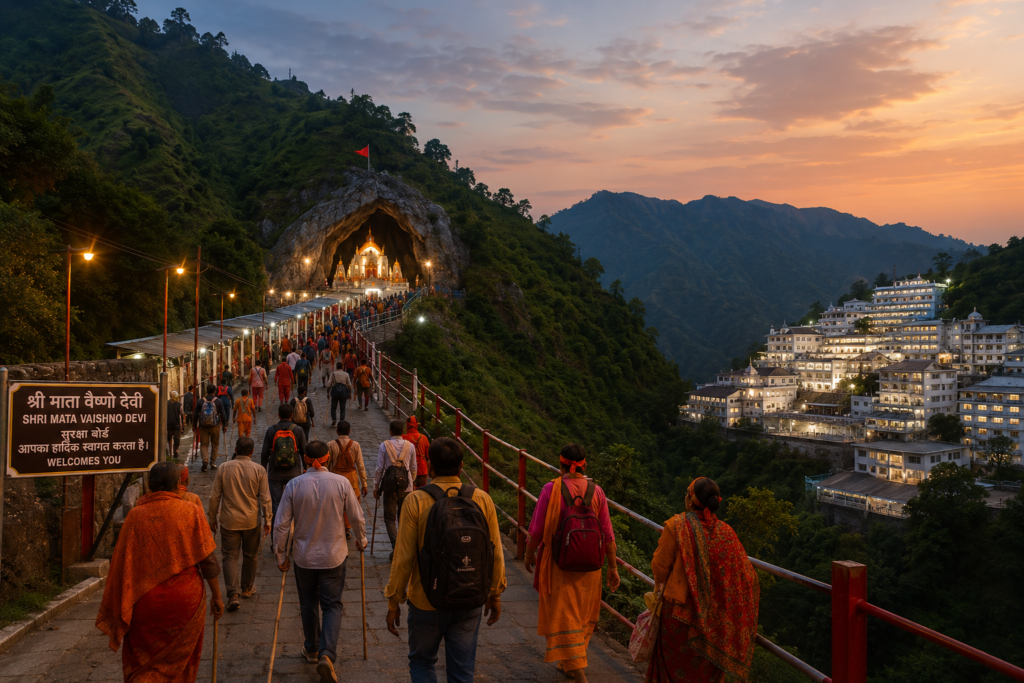
The Divine Call of the Mountains: A Journey to Shri Mata Vaishno Devi Ji
High in the rugged, misty peaks of the Trikuta Mountains in Jammu and Kashmir lies one of the most revered and spiritually magnetic shrines in the world: the holy cave of Shri Mata Vaishno Devi Ji. Nestled at an altitude of approximately 5,200 feet, this sacred destination draws millions of devotees every year, making it one of the most visited pilgrimage centers in India.
The journey begins at the bustling base camp town of Katra, from where pilgrims embark on a challenging yet deeply fulfilling 12-kilometer trek to the Bhawan. But the pilgrimage to Vaishno Devi is not merely a physical journey; it is a profound spiritual expedition. It is widely believed that no one can visit the holy shrine unless they are specifically “called” by the Mother Goddess herself—a phenomenon lovingly referred to by devotees as Ma ka Bulawa. Whether a person is wealthy or destitute, near or far, they will only find themselves at the threshold of the holy cave when the Divine Mother wills it.
This post explores the rich history, the profound spiritual significance, and the mystical manifestations of the Goddess in the form of the three sacred Pindies that reside within the ancient cave.
The Epic History and Legend of the Mother Goddess
According to ancient Hindu mythology, Mata Vaishno Devi was created by the combined spiritual energies (Tejas) of the three supreme Goddesses—Maha Kali, Maha Lakshmi, and Maha Saraswati. The primary purpose of her incarnation was to uphold righteousness (Dharma) and destroy evil forces on Earth. Born as a beautiful princess named Vaishnavi in the household of Ratnakar Sagar, she exhibited deep spiritual inclinations from a very young age. She ultimately renounced worldly life, retreating into the dense forests of the Trikuta Hills to perform intense penance (Tapasya) and meditate upon Lord Vishnu.
The most popular and defining legend associated with the shrine involves a humble, devoted village priest named Pandit Sridhar and a mystic named Bhairon Nath. Sridhar, despite living in extreme poverty, was instructed by the Goddess in a divine dream to host a massive community feast (Bhandara). Miraculously, the Goddess appeared in his home as a young girl, helping Sridhar feed the massive multitudes from a single, mysteriously inexhaustible small vessel.
Among the attendees of this feast was Bhairon Nath, a powerful but arrogant Tantric. He recognized the young girl’s divine nature but sought to capture her to attain her supreme cosmic powers for himself. Fleeing from Bhairon Nath’s aggressive pursuit, Vaishnavi retreated further into the mountains. During her flight, she paused at various spots that are now significant pilgrimage markers:
- Banganga: Where she shot an arrow into the earth to bring forth a spring and quench a monkey’s thirst.
- Charan Paduka: Where her sacred footprints remain imprinted on a rock.
- Adhkuwari: Where she meditated in a narrow, womb-like cave, known as the Garbh Joon, for nine months.
Eventually, she reached the main holy cave at Bhawan. When Bhairon Nath cornered her there, she assumed the terrifying, omnipotent form of Maha Kali and severed his head, which flew to a distant hilltop. Realizing his folly in his dying moments, Bhairon Nath pleaded for forgiveness. The compassionate Mother granted him a boon: every pilgrim’s journey to her shrine would only be considered complete after visiting the Bhairon temple. Following this epic confrontation, Mata Vaishnavi shed her human form and immersed her divine presence into a massive rock inside the cave, manifesting as the holy Pindies.
The Spiritual Significance of the Yatra
The pilgrimage to Mata Vaishno Devi is a powerful metaphor for the human soul’s journey toward divine realization. The arduous 12-kilometer climb tests the physical endurance and mental fortitude of the devotees, demanding a complete surrender of the ego. As pilgrims chant “Jai Mata Di” (Victory to the Mother Goddess) in unison echoing through the valleys, a profound sense of equality permeates the atmosphere. Differences of caste, creed, wealth, and social status dissolve entirely on the mountain paths; everyone is simply a child of the Mother, seeking her boundless grace.
The Goddess is worshipped as the ultimate symbol of Shakti (cosmic feminine energy). She is the nurturing mother who protects her children, the fierce warrior who annihilates ignorance and evil, and the bestower of wealth, wisdom, and spiritual liberation. Devotees visit the shrine with various intentions—some seek material blessings, others pray for health and familial harmony, while many simply come to express gratitude for answered prayers.
The profound peace experienced upon reaching the sanctum sanctorum, after hours of grueling walking, is often described by pilgrims as an indescribable spiritual ecstasy. It is a place where faith transcends logic, and the heart connects directly with the divine frequency of the universe. The pain of the physical climb is entirely washed away by the spiritual relief of arriving at the Mother’s doorstep.
The Sanctum Sanctorum: Decoding the Three Pindies
The absolute climax of the pilgrimage is the entry into the ancient Holy Cave. Unlike most traditional Hindu temples, the sanctum of Shri Mata Vaishno Devi does not house man-made idols, statues, or sculpted images of the Goddess. Instead, the Divine Mother reveals herself in a completely natural, Swayambhu (self-manifested) form—as three rock heads protruding from the base of the holy cave.
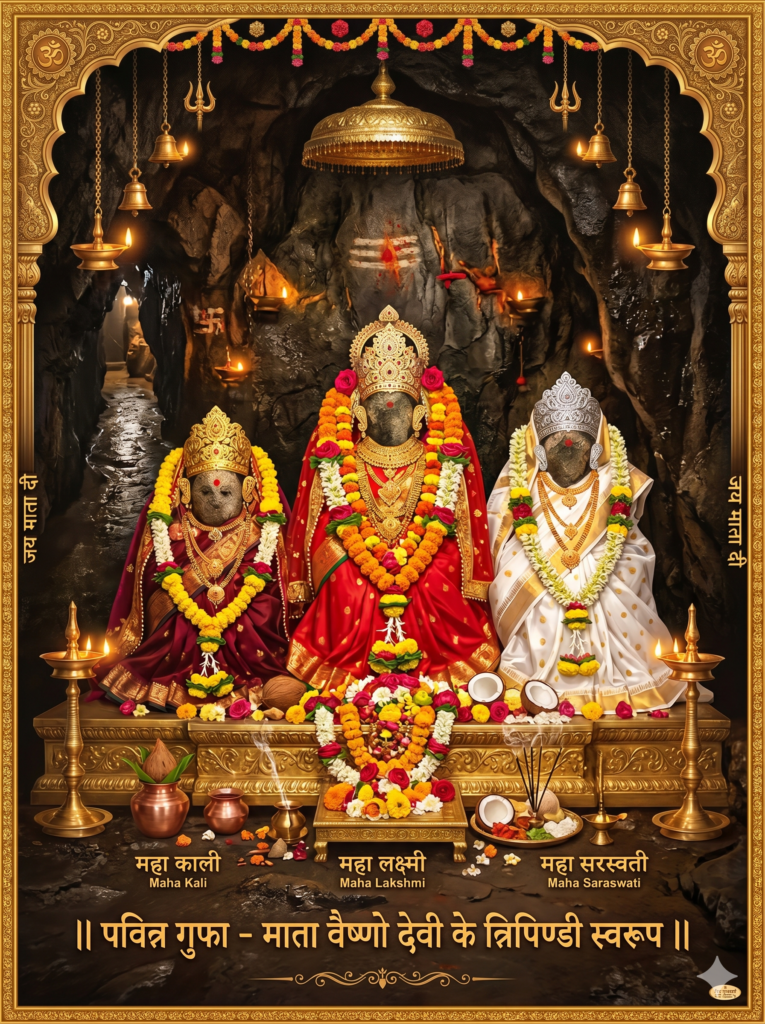
These natural rock formations are known as the Pindies. Though they stem from the same single rock base, they possess distinct colors and textures. The three Pindies are seated together, representing the ultimate trinity of the supreme feminine power, embodying the three Gunas (fundamental qualities) of the universe.
1. Maha Kali (The Right Pindi)
Positioned on the right side of the devotee as they look at the sanctum, the first Pindi represents Goddess Maha Kali.
- Characteristics: She is characterized by the color black, corresponding to the Tamas Guna (the quality of mystery, dissolution, and the unknown).
- Significance: Maha Kali is the fierce, fiercely protective aspect of the Divine Mother. She is the destroyer of evil, human ego, and deep-seated ignorance. Worshipping her grants devotees the supreme strength to overcome their inner demons, conquer irrational fear, and face the toughest, darkest challenges of life with unwavering courage and conviction.
2. Maha Lakshmi (The Center Pindi)
In the middle sits the largest and most prominent of the three, the Pindi of Goddess Maha Lakshmi.
- Characteristics: She is characterized by a yellowish-red hue, representing the Rajas Guna (the quality of passion, dynamic activity, and preservation).
- Significance: Maha Lakshmi is the supreme Goddess of wealth, prosperity, auspiciousness, and worldly sustenance. She provides the necessary material and spiritual resources for a fulfilling, joyful life. Her central position signifies that while action, wealth, and sustenance are central to human existence, they must be perfectly balanced and surrounded by knowledge (Saraswati) and protection (Kali).
3. Maha Saraswati (The Left Pindi)
On the far left side of the devotee lies the Pindi of Goddess Maha Saraswati.
- Characteristics: She is characterized by a distinct whitish hue, symbolizing the Sattva Guna (the quality of absolute purity, peace, truth, and creation).
- Significance: Maha Saraswati is the Goddess of supreme wisdom, intellect, arts, and learning. She dispels the darkness of ignorance with the brilliant light of knowledge. Her blessing is essential for spiritual growth, clear thinking, emotional intelligence, and attaining true liberation (Moksha).
Together, these three Pindies symbolize the holistic nature of the entire cosmos—creation, preservation, and dissolution. They serve as a powerful reminder to devotees that true balance and happiness in life are achieved only when purity and wisdom (Saraswati), passionate action and prosperity (Lakshmi), and protective, fearless strength (Kali) are completely in harmony.
Conclusion
The journey to Shri Mata Vaishno Devi is an epic odyssey of faith, physical resilience, and ultimate spiritual awakening. The very moment a devotee stands before the three holy Pindies inside that dimly lit, sacred cave, all exhaustion vanishes. It is immediately replaced by a profound surge of divine love and tranquility. The Mother Goddess, in her triad form, silently watches over her children, dispensing blessings that resonate long after the arduous descent back to the plains. To visit Vaishno Devi is not merely to complete a mountain trek; it is to answer the highest calling of the soul, returning home with a heart full of unshakeable faith and lips forever whispering,
“Jai Mata Di.”
Author Profile

- The Bijli Engineer is an education and career content writer contributing to JammuKashmirInfo.com, with a focus on Jammu & Kashmir education, government jobs, competitive examinations, and student guidance.
Latest entries
 BlogSeptember 1, 2026JKSSB Class IV Recruitment 2026 Notification Out, Apply Online For 2863 Vacancies
- BlogAugust 21, 2026lesson
 BlogAugust 17, 2026JK STUDY BUDDY CLASS 7 WEEKLY QUIZ SUBJECT SST
- BlogAugust 17, 2026JK STUDY BUDDY CLASS 7 WEEKLY QUIZ SUBJECT MATH