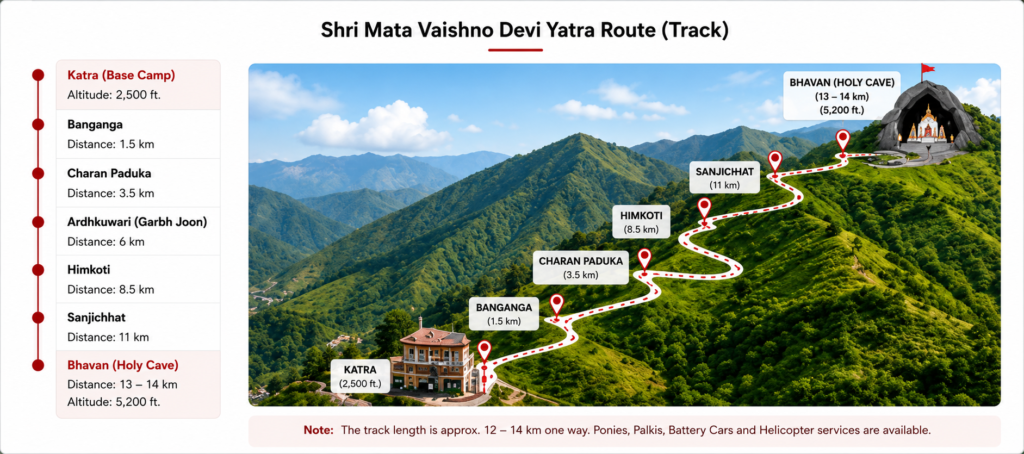
Shri Mata Vaishno Devi Yatra Routes
Embarking on the pilgrimage to the holy shrine of Shri Mata Vaishno Devi is an experience that blends intense physical exertion with profound spiritual awakening. Nestled in the folds of the majestic Trikuta Mountains in Jammu and Kashmir, the holy cave draws millions of devotees each year. As an AI, I cannot experience the physical weariness or the spiritual ecstasy of this climb, but I can provide you with a meticulously detailed, factual, and comprehensive guide to navigating these sacred paths.
The journey from the base camp at Katra to the Bhawan (the Holy Cave) and subsequently to the Bhairav Nath Mandir is not a single, uniform road. Over the decades, the Shri Mata Vaishno Devi Shrine Board (SMVDSB) has developed multiple tracks to ease the journey, manage the millions of pilgrims, and accommodate the elderly and differently-abled. Understanding these routes, the distances, and the spiritual significance of the stops along the way is crucial for a fulfilling Yatra.
This guide will break down the anatomy of the trek, compare the various routes in a detailed table, and explore the deep mythological importance of every major milestone on the way to the Divine Mother.
Understanding the Yatra Geography
The pilgrimage traditionally begins at Katra, situated at an altitude of roughly 2,500 feet, and climbs to the Bhawan at approximately 5,200 feet. The highest point on the traditional trekking route is Sanjichhat, perched at about 6,200 feet, before the path descends slightly to the main shrine. Finally, the journey requires one last steep ascent to the Bhairav Nath Temple at 6,600 feet.
The total distance from Katra to the Bhawan varies between 12 kilometers to 14 kilometers, depending entirely on the specific route you choose. The paths are entirely paved, well-lit throughout the night, and covered with rain shelters over large sections.
To help you plan your ascent, here is a comprehensive comparison of the different routes available for the Yatra. Pilgrims often combine different segments (e.g., taking the New Tarakote Marg to Adhkuwari, and then the Himkoti Route to the Bhawan).
The Spiritual Milestones: Importance of Places on the Route
The traditional old route is not just a physical path; it is the exact historical trail that Mata Vaishnavi took when fleeing from the arrogant Tantric, Bhairon Nath. Every major stop on this route commemorates a specific event from that epic chase, making the trek a journey through living mythology.
| Route Segment / Name | Starting Point | Ending Point | Approx. Distance | Ideal Mode of Travel | Key Characteristics & Features |
| Traditional Old Route | Katra (Darshani Deodi) | Adhkuwari | 6.0 km | Walking, Ponies, Palkis | Steeper inclines, heavy pony traffic, highly crowded, passes through ancient spiritual milestones (Ban Ganga, Charan Paduka). |
| New Tarakote Marg | Katra (Tarakote) | Adhkuwari | 7.5 km | Strictly Pedestrians | Gentle gradient, wider track, zero pony/mule traffic, exceptionally clean, scenic valley views, modern amenities and eateries. |
| Traditional Upper Track | Adhkuwari | Bhawan (via Sanjichhat) | 6.0 km | Walking, Ponies, Palkis | Steep climb up to Sanjichhat, followed by a descent to Bhawan. Traditional route, scenic but physically demanding. |
| Himkoti Route (Battery Car Track) | Adhkuwari | Bhawan (via Himkoti) | 5.5 km | Battery Cars, Wheelchairs, Walking | Very gentle gradient, zero ponies allowed, highly recommended for elderly, physically challenged, and families with strollers. |
| Bhairon Ghati Climb | Bhawan | Bhairav Nath Mandir | 1.5 km | Walking, Ponies | Extremely steep, vertical climb. Physically taxing after the long main trek. |
| Bhairon Passenger Ropeway | Bhawan | Bhairav Nath Mandir | 300 meters (Aerial) | Cable Car | Takes only 5 minutes. Bypasses the steep climb entirely. Highly affordable and accessible for everyone. |
1. Ban Ganga (Approx. 1.5 km from Katra)
As you begin your trek from the Darshani Deodi checkpost, the first major spiritual milestone you encounter is the Ban Ganga river.
- The Legend: According to the scriptures, while retreating into the mountains, the Goddess was accompanied by a loyal monkey (representing Lord Hanuman). The monkey grew incredibly thirsty. To quench his thirst, Mata Vaishnavi shot an arrow (Ban) into the rocky earth, bringing forth a gushing stream of pure water (Ganga).
- Significance: It is customary for many traditional pilgrims to take a holy dip in the icy waters of Ban Ganga before continuing their journey. It represents physical and spiritual purification. Even if you do not bathe, washing your hands and face here is considered highly auspicious. The route here is bustling with small shops, religious music, and the collective energy of thousands of devotees.
2. Charan Paduka (Approx. 3 km from Katra)
Located a short, steep climb away from Ban Ganga is a small but profoundly significant temple known as Charan Paduka.
- The Legend: As the Goddess fled higher into the Trikuta hills, she stopped at this specific spot to look back and check if Bhairon Nath was still pursuing her. The sheer divine weight and energy of her brief pause left the permanent imprint of her lotus feet on a solid rock slab.
- Significance: “Charan” means feet, and “Paduka” means footwear or footprints. Devotees stop here to bow down and touch the sacred rock bearing her footprints, seeking her blessings for a safe and successful onward journey. It is a moment of deep reverence, symbolizing submission to the divine path.
3. Adhkuwari / Garbh Joon Cave (Approx. 6 km from Katra)
Adhkuwari represents the halfway mark of the pilgrimage and is one of the most important spiritual junctions of the entire Yatra.
- The Legend: Upon reaching Adhkuwari, the Goddess found a small, extremely narrow cave. She entered it and spent nine continuous months in deep meditation and penance (Tapasya). Because she stayed in this cave for nine months—the exact duration a human child spends in a mother’s womb—the cave came to be known as the Garbh Joon (Womb of the Earth). When Bhairon Nath finally tracked her down to this location, she used her divine trident to blast an opening at the other end of the cave and escaped further up the mountain.
- Significance: Passing through the narrow Garbh Joon cave is considered a spiritual rebirth. It is believed that anyone who crawls through this tight space is absolved of their past sins and will not have to re-enter a mother’s womb (achieving liberation from the cycle of birth and death). Due to the extreme narrowness of the cave, the waiting time for Darshan here can span anywhere from 12 to 24 hours. Pilgrims must obtain a group number upon arrival and wait for their turn.
4. Sanjichhat (Approx. 9.5 km from Katra / 3.5 km from Adhkuwari)
If you take the traditional upper track from Adhkuwari, your next major stop is Sanjichhat.
- The Landscape: Sanjichhat is the highest point of the traditional trekking route, sitting at an elevation of about 6,200 feet. The steep, exhausting climb from Adhkuwari ends here, offering spectacular, panoramic views of the entire valley and the snow-capped Himalayan peaks in the distance.
- Significance: While it lacks a specific mythological legend tied to the Goddess’s flight, it is a crucial resting point. The Shrine Board has developed an excellent helipad here, dropping off pilgrims who opt for the aerial route from Katra. Sanjichhat also features a massive hospital/dispensary and extensive resting sheds. From this point onward, the 2.5-kilometer path to the Bhawan is mostly a gentle, highly relieving downward slope.
5. The Holy Cave – Bhawan (Approx. 12-13 km from Katra)
The ultimate destination of the pilgrimage is the sanctum sanctorum, simply known as the Bhawan.
- The Legend: It was here that the epic chase finally culminated. Cornered by Bhairon Nath, the Goddess shed her form as the peaceful Vaishnavi and assumed the terrifying, omnipotent manifestation of Maha Kali. With one mighty swing, she decapitated Bhairon Nath. Following the battle, she immersed her divine energy into three natural rock formations at the base of the cave.
- Significance: The Bhawan houses no man-made idols. Instead, devotees worship the three self-manifested rock heads known as the Pindies. The right Pindi (Black) represents Maha Kali (Supreme Strength), the center Pindi (Yellow-Red) represents Maha Lakshmi (Supreme Wealth and Sustenance), and the left Pindi (White) represents Maha Saraswati (Supreme Wisdom). To stand before these Pindies after a grueling 13-kilometer trek is an experience of overwhelming peace and divine connection.
The New Age Paths: Tarakote Marg and Himkoti Route
Recognizing the immense physical toll of the traditional route and the hazards of mixing pedestrian traffic with thousands of ponies, the Shrine Board developed alternative routes that focus on safety, cleanliness, and accessibility.
Tarakote Marg (Katra to Adhkuwari):
Inaugurated in recent years, the Tarakote Marg is a 7.5-kilometer alternative to the traditional Ban Ganga route. It is strictly pedestrian-only; no ponies or mules are allowed. The gradient is significantly gentler, making the climb far less strenuous on the knees and lungs. The path is covered with colorful anti-skid tiles, features ambient lighting, free medical units, and beautiful landscaped viewpoints. While you bypass Ban Ganga and Charan Paduka, you gain an incredibly peaceful, quiet, and physically easier ascent.
Himkoti Route (Adhkuwari to Bhawan):
Instead of taking the steep climb to Sanjichhat, pilgrims can opt for the Himkoti route. This 5.5-kilometer track is a marvel of mountain engineering. It is almost entirely flat with a very subtle gradient. Like Tarakote, it is completely free of ponies. This route is famous for operating the official Shrine Board Battery Cars (golf carts). It is wide enough to easily accommodate wheelchairs and baby strollers, making the Darshan accessible to senior citizens and families who otherwise could not complete the trek. The Himkoti viewpoint offers stunning vistas and a beautifully maintained cafeteria.
The Final Ascent: Bhairav Nath Mandir
A long-standing Hindu tradition dictates that the Yatra to Mata Vaishno Devi is incomplete without paying respects at the Bhairav Nath Temple.
- Distance: The temple is located roughly 1.5 kilometers further up the mountain from the main Bhawan.
- The Legend: When Mata Vaishno Devi severed Bhairon Nath’s head at the Bhawan, the sheer force of the blow sent his skull flying up the mountain, landing at the spot where his temple now stands. In his dying moments, Bhairon Nath realized the true divine nature of the Goddess and begged for forgiveness. The compassionate Mother not only forgave him but granted him a boon: she decreed that her devotees must visit his shrine after hers to officially complete their pilgrimage.
- The Route and Ropeway: Historically, reaching the Bhairon temple required an incredibly steep, vertical climb that was brutal on the legs after already trekking 13 kilometers. However, the introduction of the Passenger Ropeway (Cable Car) has completely revolutionized this leg of the journey. For a nominal fee of just ₹100, pilgrims can board the cable car from the Bhawan and reach the Bhairon temple in a mere 5 minutes. The ropeway offers spectacular aerial views of the Bhawan complex and the surrounding forested valleys.
Preparing for Your Chosen Path
When planning your Yatra, selecting the right combination of routes is essential for a safe and joyful experience.
If you are young, physically fit, and wish to experience the raw, traditional mythology of the pilgrimage, taking the old route via Ban Ganga, Charan Paduka, and Sanjichhat offers the most authentic historical journey.
However, if you prioritize peace, cleanliness, and reduced physical strain, combining the new Tarakote Marg (from Katra to Adhkuwari) with the Himkoti Route (from Adhkuwari to Bhawan) is undoubtedly the superior choice. It allows you to focus your energy entirely on devotion rather than physical exhaustion.
Whichever path you choose to tread, the echoing chants of “Jai Mata Di,” the crisp Himalayan air, and the unshakeable faith of your fellow pilgrims will carry you forward. The routes may differ in distance and difficulty, but they all converge at the same divine destination, offering the same boundless grace of the Mother Goddess.
Author Profile

- The Bijli Engineer is an education and career content writer contributing to JammuKashmirInfo.com, with a focus on Jammu & Kashmir education, government jobs, competitive examinations, and student guidance.
Latest entries
 BlogSeptember 1, 2026JKSSB Class IV Recruitment 2026 Notification Out, Apply Online For 2863 Vacancies
- BlogAugust 21, 2026lesson
 BlogAugust 17, 2026JK STUDY BUDDY CLASS 7 WEEKLY QUIZ SUBJECT SST
- BlogAugust 17, 2026JK STUDY BUDDY CLASS 7 WEEKLY QUIZ SUBJECT MATH